
Maritime Agencies
Shippers’ Council, Nigeria Railway Corporation Partner To Promote Cargo Transshipment By Rail.

By Izuchukwu Ozoemena
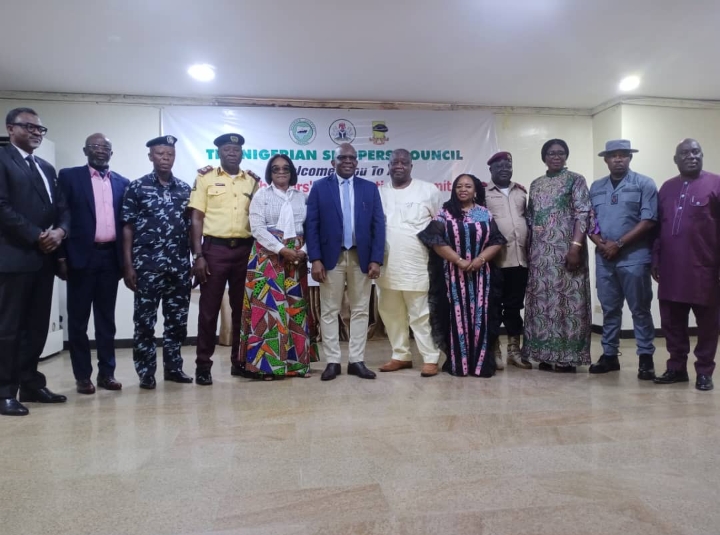
To resolve numerous problems of cargo movement through the rail, the Nigerian Shippers’ Council (NSC) and the Nigerian Railway Corporation (NRC), Thursday, entered into a Memorandum of Understanding (MoU) to collaborate and promote effective transshipment of cargo to all nooks and crannies of the country, going forward.
The MoU marked the highlight of events at a one-day stakeholders’ summit in Lagos on the theme “Limitations To Rail Transportation of Cargo in Nigeria”.
Declaring the well-attended event open, the NSC Executive Secretary, Barr. Pius Akutah, MON, harped on the need to increase exports, saying that more than ever before, the port economic regulator is set to identify and resolve challenges bedeviling cargo transportation in Nigeria.
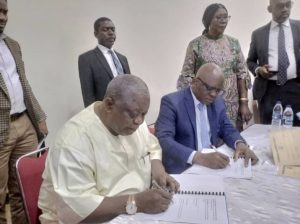
Seated: Engr Fidet Okhiria, MD, NRC and Barr Pius Akutah, ES, NSC signing the MoU.
“We are working with the NRC,” he stated, “to encourage railway utilization for cargo evacuation and conveyance of goods from hinterlands to the ports.”
“Railway has been found to be the best mode for transporting cargoes in terms of safety and it is also cost-efficient. This MoU with NRC is to develop policies and infrastructure to enhance the use of railway for cargo transshipment.”
“Nigeria is looking at improving its exports under the present government. This is also important to make Nigerians benefit from the African Continental Free Trade Agreement (AfCFTA) trade. If Nigerians are going to favourably compete in the regional trade, then the cost of transportation for moving cargoes to seaports must be reduced.”
The ES disclosed that the Ministry of Marine and Blue Economy is working on a policy to address infrastructure deficits at Nigerian ports part of which is involving private sector investors since the government cannot do it all.
The NSC’s partnership with the NRC, he said, will facilitate the development and use of inland container depots all over Nigeria.
In his remarks, Engr Fidet Okhiria, Managing Director, NRC, described the MoU as a work tool for his agency and the NSC to jointly confront the problems militating against seamless rail cargo movement to and from the seaport terminals to the advantage of shippers. However, his worry is the availability of cargoes to be conveyed.
“The last time we moved about 17 containers to Kano, it took us a very long time to gather these containers. We also try to encourage manufacturers to come together so that we can move their goods in bulk,” Okhiria said.
He called on terminals with access to railway lines to provide an enabling environment for importers and exporters to move their cargo by rail.
Speaking on what she described as the poor patronage of rail haulage, Mrs Chinwe Ezenwa, CEO, Le Look Bags, advised the NRC to do more publicity and sensitization on its railway cargo routes and services.
“We are glad to have witnessed this MoU between NRC and Shippers’ Council because we are in the business of exports. But witnessing the MoU is one thing and having it effectively executed is a completely different matter.”
She expressed optimism that if the rail system works as expected, the cost of manufacturing and other overheads would surely go down.
“Surely an optimized railway system will bring done the cost of manufacturing. There are some raffia we need for manufacturing that are found in Cross River State and it is so expensive to move by road. Moving by railway makes it cheaper and enables us save cost,” she explained.
Explaining the role of the Nigeria Customs Service (NCS) in evacuation of cargoes from seaports, the Customs Area Controller, Tin Can Island Port Command, Comptroller Deraa Nnadi, mni, observed that the Service inspects and documents cargoes before they exit the seaports.
Nnadi encouraged shippers and their freight agents to gainfully utilize the Pre-Arrival Assessment Report (PAAR) to have an estimate of the cost of Customs duty and expedite cargo clearance.
While emphasizing the need for Nigeria to pay greater attention to exports, he described the NSC/NSC MoU as commendable.
In her goodwill message, the Chairperson, Apapa Local Government Council, Hon (Mrs) Idowu Sebanjo, lamented that her local government and residents are not enjoying the dividends of being a landlord to Papa and Tincan Island ports, the biggest seaports in Nigeria.
“Government should look inwards,” she advised, “and rebuild Apapa as a strategic ports city, taking advantage of the presence of key government agencies.”
“There are no proper roads to service the train stations at Apapa. The Flour Mills access road isn’t sufficient and we hope that something will be done about this amid plans to refurbish the railway. Apapa isn’t benefitting from having the nation’s biggest seaports,” Sebanjo said.
In addition to the Manufacturers Association of Nigeria (MAN) and freight forwarding organizations, the Federal Road Safety Commission (FRSC), the Council for the Regulation of Freight Forwarding in Nigeria (CRFFN) and the Nigeria Police Force also attended the event.










Customs
Ogun 1 Customs Hosts FAED 2026, Highlights Gains of Cross-Border Cooperation, Economic Empowerment and Entrepreneurial Development.
By Izuchukwu Ozoemena
The Acting Customs Area Controller (CAC), Ogun Area 1 Command of the Nigeria Customs Service, Deputy Comptroller O.O.Afeni says the Festival of Arts For Economic Development (FAED) continues to reflect a shared understanding that sustainable border management goes beyond enforcement to encompass cross-border cooperation, economic empowerment and entrepreneurship development within the border communities.
Deputy Comptroller Afeni spoke at the Idiroko Border, Thursday, while declaring open the international colloquium to mark the 5th edition of the Festival of Art for Economic Development to which the Nigeria Customs Service is a strategic partner.
He said: “The theme, ‘Rebranding Borderline Communities through Creative Empowerment and Entrepreneurship,’ aligns with the Nigeria Customs Service’s commitment to supporting legitimate trade, encouraging value addition, and promoting small-scale enterprises as drivers of economic growth and border stability.

Dr Bonny Abisogun Botoku, Executive Producer, FAED.
He acknowledged the important role of the Nigeria–Benin Inter-Border Forum, under the leadership of its Permanent Secretary, Dr. Bonny Abisogun Botoku in advancing preventive diplomacy, structured dialogue and operational cooperation between Nigeria and the Republic of Benin.
”Through the empowerment programmes and entrepreneurship initiatives embedded in this Festival, we see practical pathways to reducing illicit activities, strengthening lawful commerce, and fostering inclusive economic opportunities for our people.”

Deborah Chiamaka Nwangene, one of the graduating trainees.
”The Nigeria Customs Service remains committed to partnerships that promote peaceful borders, resilient economies and sustainable regional integration.”
During a brief press chat, Comptroller Afeni spoke about enforcing government fiscal policies, saying that this must not be by force.
”The citizens must be made to know the reasons we are here. This is a way of showing the communities that we care about them. You can see that we have trained some people in the art of garri- making painting tye and dye (adire), etc. It’s a way of empowering the community.”
On suggestions that the seminar is capable of deepening cordial relationship between Benin and Nigeria, the CAC could not agree less.
”It is the fifth edition. It has been a situation we see the succeeding version getting better than the previous one. Today, I signed many certificates of people graduating. We’re not just training them; we’re empowering them so that we take them off the smuggling realm and make them better citizens.”
In his presentation, the Executive Producer of the Festival, Dr Bonny Abisogun Botoku described it as more than an event.
”It is a movement. It is a statement of belief—that border communities are not problems to be managed, but potentials to be unlocked.”
He recalled that for too long, border communities across Africa have been spoken about only in the language of risks exemplified in smuggling, insecurity, informality and marginalization.
”But those of us who live and work at the borders know a deeper truth. Borders are not just lines on maps. They are meeting points of culture, gateways of trade,
and spaces of shared history.
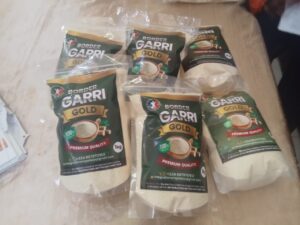
Sample of garri processed and packaged by a trainee.
”The Nigeria–Benin border is not a dividing line—it is a shared civilization. What we are doing through this Festival is to change the story from suspicion to trust, from survival to enterprise,
from isolation to integration.
Contrary to the widely-held belief that culture only concerns entertainment, he explained, culture is power, identity and economic capital.
”Through art, music, fashion, crafts, food systems, and storytelling, communities rediscover pride, cohesion, and voice.
Culture becomes a language of peace, dialogue, and diplomacy—especially in border spaces where differences must be managed with wisdom.
”This Festival deliberately places culture at the center of development, not at the margins.”
Distinguished guests at the event included the Onitaege of Itaege, HRM Oba Matthew Ademola Abisoye and other respected traditional rulers, government officials and representatives of security agencies. Others were partners from the Republic of Benin, artists, cultural practitioners and trainees.
Maritime Agencies
We’re Ever Proactive In Intercepting Prohibited, Falsely Declared Goods, says Controller Onyeka.
By Izuchukwu Ozoemena
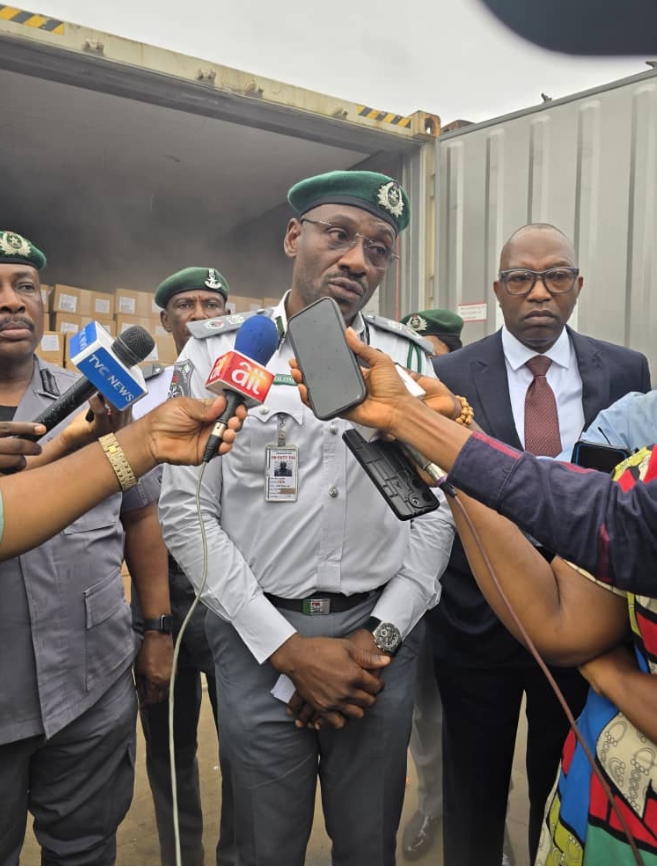
In line with the core mandate of the Nigeria Customs Service, the Tincan Island Port Command is ever proactive in intercepting prohibited and falsely declared goods even as it remains committed to facilitate legitimate trade while contributing significantly to revenue generation.
The falsely declared goods include controlled pharmaceuticals, arms and ammunition, narcotics and other items capable of undermining public safety, security and stability.
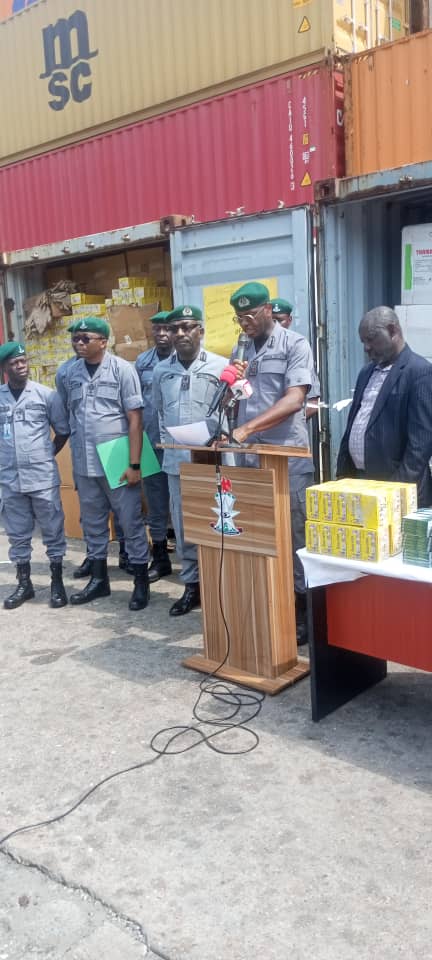
The Customs Area Controller (CAC), Comptroller Frank Onyeka stated this in Lagos, Friday, while formally handing over three (3) units of 20 ft containers containing expired pharmaceutical products to the National Food and Drug Administration and Control (NAFDAC) for appropriate regulatory action.
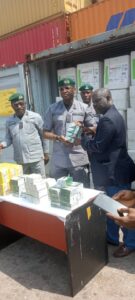
”The containers include two units with numbers PONU031958/6 and MSKU 711656/0 which were found to contain expired Tramadol tablets,” Onyeka announced.
”These consignments were thoroughly examined and the result revealed that the first container contained 86 cartons of Vingil Tramadol BP 50 mg while the second container held 250 cartons of the same expired Tramadol product”.
”The third container with number MSKU413519/1 was found to contain 370 cartons of expired Declofenac Sodium BP 50 mg tablets without a valid NAFDAC registration number, making the consignment illegal and dangerous for public use.”
Beyond these seizures, he explained, the Tincan Command has continued to record notable achievements in recent times through intensified cargo examination, improved intelligence gathering and sustained enforcement operations. These achievements are the result of deliberate strategies anchored on discipline, integrity and strong inter -agency collaboration.
He showed special appreciation to the operatives of NAFDAC for their consistent cooperation.
”Our synergy has continued to yield positive results particularly in ensuring that fake, substandard and expired drugs are intercepted before reaching the Nigerian populace.”
He equally commended officers and men of the Command for being resilient and committed to duty, a development that has continued to strengthen the credibility and operational effectiveness of the Command.
”Furthermore, I express our sincere appreciation to the Comptroller-General of Customs, Bashir Adewale Adeniyi, PhD, MFR, psc (+) for his purposeful leadership and strategic reforms which have empowered our operations.”
The CAC later handed over the prohibited pharmaceuticals to Mr Kareem Taiwo Adekunle, the Chief Regulatory Officer (Investigation and Inspection Directorate), NAFDAC, Apapa.
Maritime Agencies
Zone ‘A’ Coordinator, Mohammed Babandede, Visits Apapa Command, Commends Officers’ Sterling Performance.

By Izuchukwu Ozoemena
Officers and men of the Apapa Customs Command have received a special commendation for maintaining an exceptional performance in revenue generation, anti-smuggling operations and trade facilitation throughout 2025.
Mohammed Babandede, Assistant Comptroller-General of Customs (ACG) and Zonal Coordinator, Zone ‘A’ of the Nigeria Customs Service handed down the commendation during his familiarization visit to the Command, Thursday.
Chief Superintendent of Customs, Isa Sulaiman, the image maker of the Apapa Customs Command disclosed this in a press release.
Addressing officers and men during the visit, the image maker stated, the Zonal Coordinator explained that the purpose of his coming was to acknowledge the operational challenges faced by the Command, appreciate its notable achievements and further boost the morale of personnel who have consistently surpassed expectations, particularly in revenue collection where the Command exceeded its annual target.
”The ACG also lauded the Command’s sustained anti-smuggling efforts, especially the significant seizures of narcotics and other illicit substances including cocaine and tramadol, describing these interceptions as critical contributions to national security, public health and societal safety. ”
Effective enforcement, the ACG emphasized, remains fundamental to creating a secure environment for legitimate trade to thrive.
While noting that the core responsibilities of the Service extend beyond revenue generation to include national security, public safety and trade facilitation, the Zonal Coordinator commended the Apapa Command for its effective inter-agency collaboration. He urged officers to deepen cooperation with sister agencies, particularly in the deployment and promotion of trade facilitation tools that have positioned the Service at an upper-class operational rating.
The Zonal Coordinator further stressed the importance of integrity, reputational management, mentorship and capacity building within the Command. He urged senior officers to transfer knowledge and experience to younger officers while also drawing attention to the importance of officers’ welfare and health, disclosing that drug tests would be conducted across Commands. He advised officers to remain health-conscious for effective service delivery.
In his remarks, the Customs Area Controller, Apapa Area Command, Comptroller Emmanuel Oshoba, expressed appreciation to the Zonal Coordinator whose February 5 visit was motivating and timely. He reaffirmed the Command’s commitment to sustaining its performance in revenue generation, enforcement, trade facilitation, inter-agency cooperation and ethical conduct in strict adherence to the Nigeria Customs Service Act, 2023 and the policy thrust of the Comptroller-General of Customs, Dr Adewale Adeniyi.


Ogun 1 Customs Hosts FAED 2026, Highlights Gains of Cross-Border Cooperation, Economic Empowerment and Entrepreneurial Development.

We’re Ever Proactive In Intercepting Prohibited, Falsely Declared Goods, says Controller Onyeka.

Zone ‘A’ Coordinator, Mohammed Babandede, Visits Apapa Command, Commends Officers’ Sterling Performance.

Freight Forwarders Warn FAAN To Halt New Charges In Airport Cargo Operations or Risk Rumble in the Sector .

Lekki Deepsea Port: The Success Story of the Nigerian Ports Authority.

NAGAFF Pledges Watertight Enforcement, Unveils A More Formidable 100% Compliance Team.

PTML Customs Hands Over Seized Arms and Ammunition, Collects N44.06bn in January.

NAGAFF Compliance Team Set to Relaunch for Stronger Engagement, Enforcement.

WAR AGAINST KILLER DRUGS: Apapa Customs, NDLEA Collaborate To Nab Huge Quantity of ‘Canadian Loud’.

Seme Customs Raids Hideouts, Impounds 200 Bags of Smuggled Rice, Collects N2bn 3 Weeks into 2026.

Lekki Deepsea Port: The Success Story of the Nigerian Ports Authority.

OGUN AREA 1 CUSTOMS: Suspected Armed Drug Traffickers Mount Barricades, Attack Officers. Two Personnel Critically Injured.

KLT Customs Surpasses 2025 Revenue Target By a Wide Margin, Clamps Down on Expired Imports.

Suspend Charges Review, Engage Stakeholders, Shippers’ Council Tasks Shipping Companies

FG Inaugurates Nigerian Shippers’ Council Board, Highlights Need for Reduced Port Costs, Fair Pricing.

OIL FACILITIES PROTECTION: Tompolo’s Tantita Acquires High-Tech Drones From US Firm.

1. EXECUTIVE PLATFORM. AMES 2024: TIME TO CHANGE GOVERNMENT ATTITUDE TOWARDS SHIPPING DEVELOPMENT IS NOW, AMES President Charges FG.

APFFLON Seeks Immediate Reform of CRFFN, Replacement of Registrar.

2023 ELECTIONS:CILT Hosts Seminar on Logistics & Electoral Process

OMIS AWARDS, 2022: Greg Ogbeifun, Industry Gurus For Special Recognition.

B’ODOGWU TRADE PORTAL: Customs Consolidates, Pilots Form ‘M’ Processing.

FG Set To Re-establish National Shipping Line, To Take Advantage of $10 bn Annual Ship Charter Market.

INLAND WATERWAYS OFFERS NIGERIA ALTERNATIVE REVENUE SOURCE, Says Sambo

Sylvanus Ekpo, ex-Editor, Shipping World Magazine, loses Mum

Photo News: Salah Celebration

PHOTO NEWS: Maritime Capacity Development

WAR AGAINST OIL THEFT: Tompolo’s Company Nabs VLCC Laden With Crude Oil

MAN, ORON: It’s Encomiums Galore From International Seabed Authority (ISA).

Lilypond Export Command Is Meeting Expectations, Handles 70% of Nigeria’s Total Tonnage of Export Cargo, says CAC Odusanya.

BENIN SEAPORT UPDATE: Edo State Government, Host Communities, Conduct Bidders To Inspect Project Site.
HALF YEAR, 2024: Apapa Customs Nets ₦1.024 Trillion, Records 143% Increase.

Mama Theresa Enisuoh Due For Burial April 27

-
 Customs3 weeks ago
KLT Customs Surpasses 2025 Revenue Target By a Wide Margin, Clamps Down on Expired Imports.
-
 Customs2 weeks ago
Freight Forwarders Warn FAAN To Halt New Charges In Airport Cargo Operations or Risk Rumble in the Sector .
-
 Maritime Agencies3 weeks ago
OGUN AREA 1 CUSTOMS: Suspected Armed Drug Traffickers Mount Barricades, Attack Officers. Two Personnel Critically Injured.
-
 Maritime Agencies3 weeks ago
WAR AGAINST KILLER DRUGS: Apapa Customs, NDLEA Collaborate To Nab Huge Quantity of ‘Canadian Loud’.
-
 Customs3 weeks ago
Lekki Deepsea Port: The Success Story of the Nigerian Ports Authority.
-
 Customs2 weeks ago
PTML Customs Hands Over Seized Arms and Ammunition, Collects N44.06bn in January.
-
 Maritime Agencies3 weeks ago
NAGAFF Compliance Team Set to Relaunch for Stronger Engagement, Enforcement.
-
 Maritime Agencies3 weeks ago
Seme Customs Raids Hideouts, Impounds 200 Bags of Smuggled Rice, Collects N2bn 3 Weeks into 2026.