
Personality Interviews
MARINE & BLUE ECONOMY: Tell Us What You Want To Do Differently, SSASCGOC Challenges Oyetola.

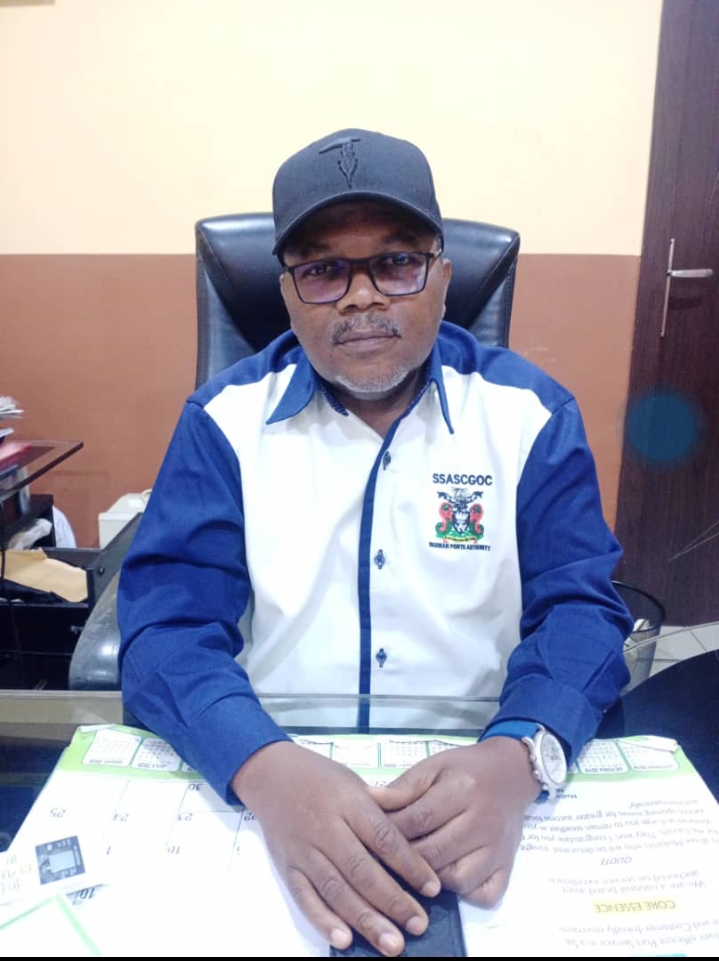
Ekiti State-born Comrade AKIN BODUNDE, the President, Senior Staff Association of Statutory Corporations and Government-Owned Companies (SSASCGOC), is of the HR Department of the Nigerian Ports Authority, NPA. He is a personality who is grounded in maritime labour issues at the junior and senior levels. In this special interview with Falcon Watch Online, he discusses maritime labour matters from the perspective of one with deep knowledge. As the SSASCGOC welcomes the creation of a new Marine and Blue Economy Ministry, he challenges the government to quickly come up with a blueprint on many unanswered questions regarding the new creation and what differences Nigerians should expect in her operations, going forward. He spoke to IZUCHUKWU OZOEMENA.
Q: You’re often noticed in events organized by the Maritime Workers’ Union of Nigeria (MWUN).
What’s the relationship between the Senior Staff Association of Statutory Corporations and Government Owned Companies (SSASCGOC) and the MWUN?
Ans: MWUN and the SSASCGOC are twins. We work together. In NPA, we have two major unions – the SSASCGOC and the MWUN. SSASCGOC belongs to senior officers from level 8 and above while the MWUN is for junior officers. We work together; we do things as a group. If we’re writing to Management as a group, for instance, we fight together.The MWUN President- General is a father to all! We respect him. He coordinates properly and that’s the reason you witness the harmony between us. Anything we’re doing, they’re there; anything they’re doing, we’re there.
We are partners-in-progress.
Q: What’s your impression about ‘Maritime Labour Voice’, an inhouse magazine MWUN recently unveiled?
Ans: It’s not a new thing in the maritime labour industry. I hope the initiative will be sustained. We at SSASCGOC will start ours soon. That’s why we were there to encourage them. We pray they sustain it because we need to make the noise ourselves. You cannot rely on people to do the shouting for you. Our own magazine can go many areas and people will hear us better. I really appove the move of the PG towards that direction. It’s a good initiative and we support it totally.
Q: The Marine and Blue Economy Minister talks about refloating the moribund NNSL without any pronouncement on the erstwhile seafarers whose entitlements have not been cleared.
Ans: I believe that was a political statement. The issue came up recently at the reception of the new ship at Grimaldi. You can’t be talking of establishing a new shipping line without knowing what is on ground. The NIMASA DG said something concerning the agreement not yet reached (on the entitlements of former seafarers involved). More than 20 years, somebody is being owed his gratuity and some of them are dead. The government and members of the maritime labour family should come to a round table and finalize it. I know the PG will fight it to the last. Bringing a shipping line now is a political statement which I don’t think is feasible. Even the Blue Economy we are talking about is all in name as the paper work has not been done. The same Permanent Secretary is still serving the two ministries – Transportation and Marine and Blue Economy. That means documentations and proper divisions have not been done. By the time they finish, let’s know the direction. For us as a union, we are waiting to know the direction they’re going. We’re sending letters to them to explain their focus. Where are the areas they want to do better than the former Minister? We’re concerned! Marine and Blue Economy is a good name as is being practised in other countries. But we cannot just imbibe the name without following the rules. Let’s see how it wants to go because there are a lot of issues. For instance, a lot of job overlaps still exist among NIMASA, Shippers Council, NPA, NIWA, etc. Don’t just change the name. Let’s look at the structure. This must be clearly stated. All these clash of interests is the major problem the new Marine and Blue Economy will address because we have raised issues with this overlap of functions which needs to be seriously looked into. Everybody is rushing to make revenue. If you make revenue generation your focus, you will lose the track. We are waiting; let’s see how it goes.
Q: You and your association didn’t attend the Minister’s recent stakeholders engagement in Lagos. Why?
Ans: We didn’t want to force ourselves to a meeting because no invitation was extended to us. Anything they’re discussing we are watching. We will still have our own meeting with him to tell him our own side of the story, the way things are being run and to propose better ways to him. We are insiders. We cannot be biased. Your stakeholders may be biased; the management may be biased. Every other person may be biased because of personal interests. But our interest is the Nigerian interest- how to run the place, make it better, more efficient and make people have access to what we are doing. When we talk to the Minister, we talk to him as Nigerians not as an interested party whose interest is what to share. We’ll be able to tell him the truth, nothing but the truth!
He should explain to us the name, Marine and Blue Economy. What does he want to do with it? What is the agenda? What is the master plan and how does he want to run it? What new thing is the new Ministry bringing on the table? A lot of things should be changed alongside the name. Maybe talking about functions or looking at areas not tapped into. Those are the things we want to see.
Q: D’you foresee the new Ministry making a difference?
Ans: Yes! The Minister made promises when he visited Lagos ports that he wants to do things better. He repeated same thing at Lekki Deep-sea Port. I don’t want to preempt him. We are hoping for the best.
What does he want to do with the new Ministry? What is the agenda? What is the master plan for it and how does he want to run it? What is the new thing the Blue Economy is bringing to the table? These are the things we want to discuss. We are not just interested in change of name. A lot of things should be changed alongside the name.
Q: D’you foresee the new Ministry making a difference?
Ans: Yes! We briefly interacted with the Minister when he visited the Apapa Port and he promised to do things better. He repeated same thing at Lekki Deep-sea Port. I don’t want to preempt him. We are hoping for the best.
Q: There are concerns that because they are jobless, many well-trained seafarers may be behind cases of oil theft and insecurity in the Niger Delta because non-specialists cannot successfully dabble into such acts. Your view?
Ans: We don’t have ships owned by Nigerians. This being so, there’s no way we can employ our people. Foreign ships that come in, discharge and go have their own crew already. Regrettably, when the Cabotage Law started with NIMASA, we expected that the focus would be how to empower our local people to own ships. If we own ships, they can’t go abroad to employ. They’ll employ from here. Unless we have indigenous lines owned by our people, no employment will be created for our people. We will continue training seafarers with certificates but doing nothing. Government should encourage home-grown shipping lines so as to have ships locally owned by Nigerians to create employment for Nigerians. An idle mind is the devil’s workshop.
Q: In the new dispensation, signing performance bond is the in-thing whereby ministers and directors under them commit to performance or be booted out. What d’you suggest government should do to anyone who fails to deliver after signing the bond?
Ans: The President himself said it that if you don’t perform, you go! Those who perform have nothing to fear. I know the minster has repeated same thing to parastatal heads under the Marine and Blue Economy Ministry. It’s a good statement. We are watching! Let’s see who becomes the first casualty in the next six months.
Q: The Nigeria Shippers’ Council has become a rolling stone that gathers no moss. As one CEO tries to have a grasp of the work he is appointed to do, he is swept off and a greenhorn appointed to start learning the ropes all over.
Ans: As a parastatal under the Marine and Blue Economy, Shippers’ Council belongs to government. It’s headship appointment is not permanent. In parastatals or government job, you can be appointed and you can be disappointed. Soldier go and soldier comes, barrack remains. However, some areas, professionals are required. When you’re changing, you should bring professionals to run them. It is true many of us graduated from schools and what we are doing are not what we learnt. Government should try to let us have professionals who understand the job to head departments. This makes the job easier and better with higher performance.
Q: How do you rate the performance of the current NPA management?
Ans: My organization, the Nigerian Ports Authority, the management headed by Mohammed Bello Koko is doing its best. We are supporting him to do more for our workers because our priority is the welfare of our members. We cannot do anything less than that.
Concerning the Ports and Harbour Bill in the National Assembly, we fought it but it is coming back. We had a press conference on it some weeks ago. We are still on it. The NIMASA bill is going to second reading. But ours has not started. We are seriously interested in the bill because there are certain items that are not good for the country. The security of the ports cannot be compromised, for instance. Some people want to take over the ports for selfish interests. The wealth of the country belongs to the people of Nigeria. It’s not for individuals. That’s the reason we’re fighting the Ports and Harbours Bill. If the Bill is clear enough that it will create jobs and opportunities for people, we don’t have problems with it. But in a situation you want to take the wealth of the country to an individual, we will not take it; we will not agree with it. That’s our position.








Personality Interviews
”NATIONAL SINGLE WINDOW WILL CUT CARGO CLEARANCE TIME BY 75%,” NAGAFF President, Tochukwu Ezisi says.

Q: The Federal Government is set to launch the National Single Window platform in the first quarter of 2026. How prepared are freight forwarders for this?
Ans: The first phase of the National Single Window will be launched on March 27, 2026, and it will be a thing of joy to freight forwarders. The NSW is a government initiative designed to enhance trade facilitation in Nigeria. It will reduce cargo clearance time by at least 75%. The Nigeria Customs Service has developed the Time Release Study, and with the Single Window in place, that study will be significantly enhanced — you will see things working much faster. For us, it is a very welcome development.
Q: Will the NSW truly facilitate trade? Is it to the benefit of freight forwarders?
Ans: Absolutely. The National Single Window is entirely about trade facilitation. When you bring all the relevant agencies onto one platform, every party can see what the other is doing in real time. Instead of going from one agency to another, back and forth, everything is in one place. That makes the clearance process faster and far less stressful. It is a major step forward for the industry.
Q: Considering the history of technology and infrastructure challenges in the sector, what are your concerns about the NSW?
Ans: In anything you do, you prepare for the worst. But the National Single Window has the full backing of the Federal Government. If any agency attempts to pull out or truncate the process, it means that agency is, in effect, challenging the authority of the Federal Government. Are they saying they are bigger than the Federal Government? Every agency is expected to key in.
Yes, we anticipate some teething problems — that is to be expected, especially with network challenges that are common in Nigeria. But from what I have seen of the NSW’s security architecture, I am confident they have what it takes. Even when issues arise, they will be resolved quickly.
Q: With the introduction of the NSW, do you expect the cost of cargo clearance to reduce?
Ans: Definitely. Bringing all these agencies together on one platform will naturally drive down costs. I do not expect stakeholders to spend more; I expect them to spend less. When everyone is visible to each other on the same system, they will be more accountable and more efficient. That transparency alone is a significant gain for this industry.
Q: What is your message to freight forwarders about the NSW?
Ans: My message is not only to NAGAFF members — it goes to all freight forwarders across Nigeria. There is an end-user training ongoing nationwide, and I strongly urge everyone to embrace it. It is very, very important. The turnout over the past few days has been encouraging, but I still want to appeal to those who have not yet registered — please do so. It is a hands-on training, it is free, and meals are even provided for participants. Do not wait until the platform is live before you start asking questions. The opportunity is here now; take advantage of it.
Q: You mentioned that the NSW will cut clearance time significantly. What is the current average time for clearing cargo from Nigerian ports?
Ans: To be honest, under the Customs Time Release Study, if your declaration is in order and there are no complications; your goods can be cleared within three to four days. And if your declaration is completely honest, goods can be out of the port within 48 hours. That is why I always emphasise honest declaration — it is the single most important thing a freight forwarder can do to speed up the process.
Q: At the start of 2026, your New Year message to members stressed the need for compliance. How has that been received?
Ans: The message resonates with what we are discussing now. Honest declaration is the key — I said it then and I will say it again. When our declarations are honest, the job becomes easier and faster for everyone: easier for Customs, faster for us the freight forwarders. I continue to implore all freight forwarders in Nigeria — honest declaration is in our own best interest and in the interest of the country.

Digital freight forwarders’ group, the African Association of Professional Freight Forwarders and Logistics of Nigeria (APFFLON) has refused to be cowed by criticisms of her concerns about what it describes as an unjust tariff hike by the West African Container Terminal (WACT), Onne Port, raising fundamental questions about the foreign terminal operator. In this personality interview granted Falcon Watch Online Daily recently, APFFLON chieftain, Otumba Frank Ogunojemite, raised fundamental questions about WACT and expressed worry that for whatever reasons, the Nigerian Shippers’ Council (NSC) appears complicit in this operational illegality.
Otumba Ogunojemite also discussed the rejuvenated Council for the Regulation of Freight Forwarding in Nigeria (CRFFN), the new Registrar and other matters.
Izuchukwu Ozoemena reports
Q: Your organization, the African Association of Professional Freight Forwarders & Logistics of Nigeria (APFFLON) is being accused of constituting an opposition to other freight forwarding groups and regulatory agencies. Do you agree?
Ans: I don’t know where the view is coming from that some people are operating illegally when you do not do your homework properly before going public. This can lead you to jail. That was the reason we had about 16 court cases when we started . CRFFN was not excluded as we took them to court. It was a dialogue with Abubakar Tsanni, the CRFFN Board Chairman, that resolved the matter out of court.
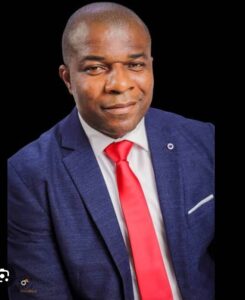
Kingsley Igwe, Registrar/CEO, CRFFN
So, when someone says APFFLON is attacking anybody, he is ignorant and not conversant with what is happening in the industry. When you’re pushed to the wall, you don’t resort to thuggery; you resort to justice. Justice is what can bring satisfaction. When you are dissatisfied with judgement, you go to appeal court rather than resorting to thuggery. So, you don’t just brand somebody without doing your own work. That’s careless talk.
We have a robust relationship with the Nigerian Shippers Council. They’re the only agency that has visited this office (the APFFLON Secretariat). But when you are taking decisions that can inflict pains on the citizens and the economy; when you are making decisions contrary to the Federal Government’s agenda, it’s a different matter.
During the National Single Window discussions, the FG admitted that the cost of doing business in Nigeria is very high and looked for ways to reduce costs to 25%. It’s not up to 60 days some people came up with 80% and 100% increament which, to us, shows injustice and an attempt to sabotage the FG’s initiatives to address port costs. Because we have a relationship, we wrote you to say ‘please look at this issue critically’. You ignored the letter. What d’you expect us to do? Do we have to leave the citizens to keep crying? Do we have to close our eyes for the economy to keep bleeding? Do we have to close our eyes on the need to alert you on what is contrary to the FG’S initiatives on port reformation and cutting costs? However, discrepancies on decisions will not affect our relationship.
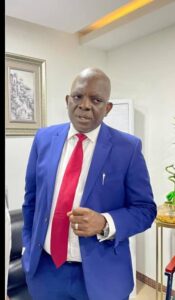
Pius Akutah, ES/CEO, Nigerian Shippers’ Council.
Q: What is the problem with operations at the West African Container Terminal (WACT), Onne, which you are kicking against?
Ans: The problem is tariff increment. It’s exactly the same time last year you increased; this time, you’re increasing. The Shippers Council said this increment was by the past Executive Secretary. If the past ES agreed on an increment, can’t the present ES do a review? The person that left did not finish his first term, talkless doing a second tenure. When we now have you onboard, you must be able to assess what was implemented in the past. If it has issues, you can suspend it. We have to reference how the Nigeria Customs suspended the 4% of FOB charges. So, why are you remaining adamant in the same industry, in the same country?
We suspected a compromise between WACT and the Nigerian Shippers Council. This has given us an insight into the establishment of WACT. How did they come to be? How long have they been there? For how long will their contract last? Are they going to have the contract for ever? These are the things that call for clarification. Don’t forget, WACT is a sister company of APMT. What is the synergy there? We need to review all these. Originally, they are from Maerskline, a foreign company. Do we fold our hands for our funds to be on capital flight? Do we continue to fold our hands and see our businesses go to foreign countries? Do we fold our hands for smuggling to continue to rise and cost of operation become unnecessarily expensive in the country? That is what calls for alarm.
Q: Pinpoint a particular way your group is suffering a disadvantage from the tariff hike by WACT.
Ans: Directly, we don’t suffer anything from the tariff hike . But indirectly, every citizen of Nigeria is suffering the high cost of living. You can check up the per capital income of individuals. For now, 20 governors are not paying the N70,000 minimum wage. But you are doing a yearly increment in the same market, in the same country. These people are very smart: they make 100% storage that will negatively affect the people. They look for an area to make money. What things justify the increment? What are they doing new? Is it the salary increment or tax increment or community support increment?
Look at the situation of things in Onne. We were there to notice that the villagers remain what they are. What are they doing differently? It’s high time we all came together to look at how to address the issues of this country. We will not continue to remain silent. APFFLON will continue to stand out and say the truth.
Q: It appears APFFLON is the only association out to say these things the way they are. Others are not saying much. Do you suspect something?
Ans: There are so many associations and issues in the industry. When we are addressing the WACT matter, other associations may be addressing other issues. For instance, haulage from Apapa, Tincan to Trade Fair, Mainland is now very costly. The network problem from banks is another matter.
Sometimes you want to capture, the bank gives you 2 or 3 days yet you cannot pay your duties. We have so many issues to bring to the table and address together. If you think they are not talking as expected, that you are a slow responder does not mean people are not talking. I read where Chief Emenike Nwokeoji of ANLCA reacted and lampooned Nigerian Shippers Council on this increment. Instead of talking about that, they’re talking about APFFLON.
It is high time the media asked the CRFFN why APFFLON is not acredited, despite her inputs so far. When someone says you are operating illegally, he should explain why and how.
Q: Government has been foot- dragging on the renewal of ports concession to private terminal operators. Is this proper?
Ans: It’s not proper. You know the reason for ports concession is the inefficiency of the Nigerian Ports Authority. Ports were concessioned to improve effectiveness and reduce costs. But what we are seeing now is exploitation by shipping and terminal operators.
After COVID 19, I expected the FG to look critically at the concession review. That time, the FG gave a directive that all consignments should be free from charges. But despite this, they collected rates from people. Shippers Council was almost losing control in trying to address the issues. We took pity with the Council for not being in control as they do not have legislative powers. That’s why we seconded them to appear on a bill so that they could have the power to be able to punish offenders. But looking at the way they are handling things now, we are beginning to feel that they are still incapacitated to handle this people even if the bill is passed.
If they cannot control the WACT tariff because somebody has agreed with them, an agreement that is not in the Act, that can be re-visited, we doubt their capacity to handle the ICTN.
Whoever is to lead this country must operate democratically. When an alert on an idea is given to you by an organization you know that has been with you for so many years, you should be able to listen and feel the pains of the citizens of this country. You should be able to support the FG’s initiatives, not going contrary to them.
So, the issue at hand is how do we survive in this country? What is going to be the contribution of each of us? Our pain is not personal; it’s for the citizens of this country. It’s for importers and exporters of this country because maritime is the economic catalyst of any country. Before the evolution of oil, maritime has always been there.
Look at the dwelling time and what they call war risk insurance. This is the amount charged a vessel on the sea as it sails through an area susceptible to piracy attack or robbery. Nigeria is one of the highest globally because shippers do not feel safe to ply our shores for fear of hijack. What is the Shippers Council doing? What’s NPA doing? What are leaders in the industry doing? Many of us in the industry do not even know what is called war risk insurance. A vessel pays $30,000 for how many days? Where will it get the money? The cost is coming back on the citizens who eventually consume the goods or services the vessels carry. Maritime theft, illegal fishing, all over, Nigeria is losing money and they are there increasing tariff. What they are looking for is an avenue for government to make more money at the expense of the suffering masses.
APFFLON will continue to do its best – advocacy. We continue to address issues as they are. We congratulate the CG of Customs following the achievement of PAAR. People have been wondering why we did that. If Webb Fontaine was not suspended, would there be B’Odogwu today. If you follow the antecedents of APFFLON in the industry, you ‘ll know that we do not joke with the issue of server provider. We are the only association that brought together the Senate and House of Reps on the issue of Webb Fontaine. The record is there.
Personality Interviews
TRADE FACILITATION: FULFIL CUSTOMS REQUIREMENTS, ENJOY AEO, B’ODOGWU, says Ayokunle.
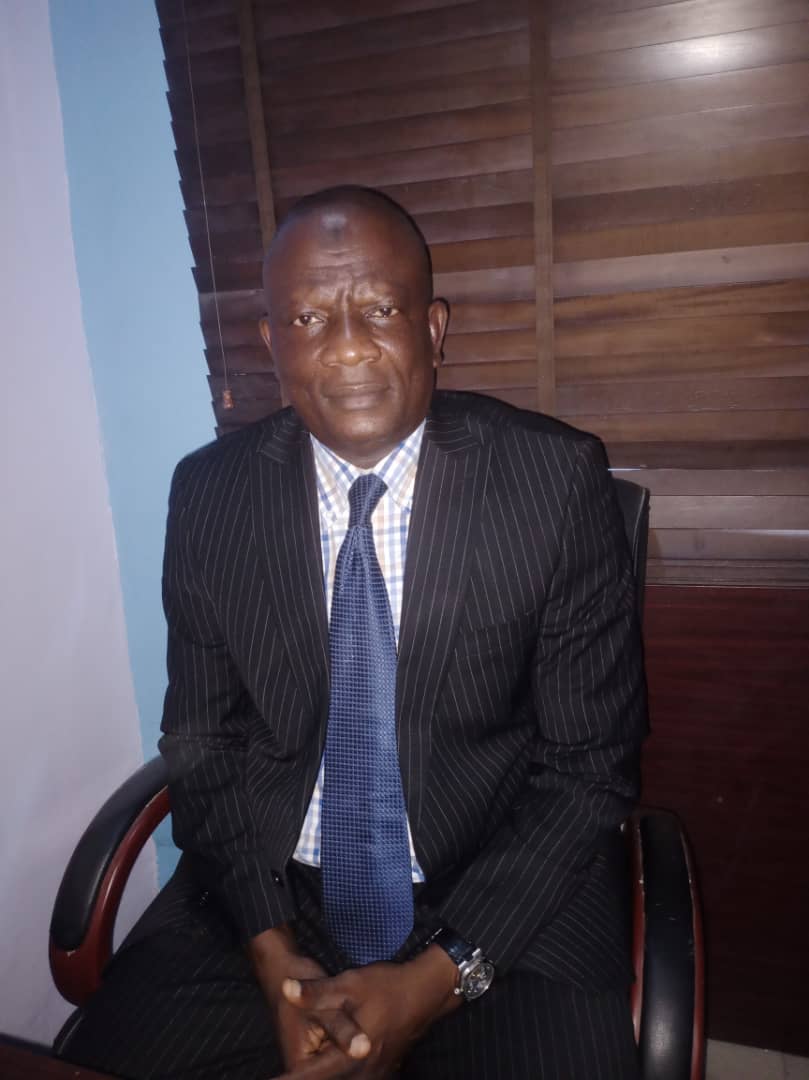
Hon Sulaimon Ayokunle, the elected Secretary of the PTML Chapter of the Association of Nigeria Licensed Customs Agents (ANLCA) is the CEO, Sula Marine Gold Ltd and SSA (Media) to the National President of the Association, Mr Kingsley Emenike Nwokeoji.
On the sidelines of the inauguration of chapter executives of the body in Lagos, Thursday, Hon Ayokunle spoke to Falcon Watch Online Daily on some trade facilitation platforms the Nigeria Customs Service (NCS) is currently implementing including the AEO, B’Odogwu, etc. How do these and other trade facilitation tools ultimately affect the operations of the average ANLCA member? According to impression in certain quarters, are customs clearing agents and other stakeholders not being subjected to payment of additional duties and loss of marginal profit they ought to make as return on investment?
Izuchukwu Ozoemena reports.
Q:
The Authorized Economic Operator (AEO) in trade facilitation is currently trending. Is it of any benefit to the customs clearing agent in the present dispensation?
Ans:
The creation of the AEO shows that it is an advanced model of fast-track procedure for cargo clearance. For you to be a beneficiary, you must meet up with certain criteria set out by the Nigeria Customs Service. What is the importance of fast-track? Fast-track is to facilitate trade for low risk importers. I’m talking about importers that are very low in risks such as manufacturers of goods who bring in homogeneous consignments in quantity. The introduction of the AEO is an advancement just to make sure that as the vessel arrives, you can take delivery of your consignment seamlessly. But you must be able to be up to the task because the condition is not just lower in terms of criteria to that of the fast-track beneficiary. It is an improvement on fast-track procedures introduced by the Customs.
Q:
Even as the AEO regime is in place, Customs talks about B’Odogwu, another trade facilitation tool. There are concerns that insufficient stakeholders sensitization should have preceded the simultaneous introduction to avoid confusion. Your take!
Ans:
They are two different things. AEO, as it is known, is basically for importers that are near 100% compliant. AEO is an improvement on fast-track procedures while B’Odogwu is now the new face of customs clearing machine. B’Odogwu is a process; AEO is a procedure. B’Odogwu is a clearing machine coming from NICISS 11 run by Webb Fontaine. When you talk about B’Odogwu, it is what we already have in the system for everybody. Whether you’re on fast-track, diplomatic or physical examination, you must pass through the B’Odogwu clearance machine.
Formerly, we were on the NICISS 11 procedure; even some of the Commands are still on NICISS 11. But B’Odogwu has come to stay at PTML.
PTML was used as a pilot scheme for B’Odogwu. It’s now moving to Tincan and Apapa. What we are telling Customs is that all the teething problems noticed at PTML must be addressed. For instance, you couldn’t connect for examination automatically, you couldn’t attach your documents, even your payment sometimes would not be through with banks used by Customs for collection of duty and other taxes. These teething problems should be sorted out. All banks ought to be integrated on the B’Odogwu clearance procedure. With the same B’Odogwu, you have different channels for clearance. Meanwhile, AEO is just another arm of the clearance process. It’s not a machine, just like you have the one that goes through physical examination, fast-track procedure and the one that involves diplomatic goods, you still have to go through B’Odogwu.
The modernization process of Customs is never static; it is still work- in – progress
The cost has been stated with import and export and, basically, they’re too many.
We are talking about reducing costs and facilitating the process and Shippers Council is talking about ICTN. They should tell us everything that surrounds cargo tracking note because to us, it is another way of adding costs to importation.
Q:
As Customs emphasizes revenue collection, how do you think government should manage the Free Trade Zones?
Ans:
Free Trade Zones are supposed to add to the GDP of the economy. You know it is a special zone for production from where other goods will be exported, not that Customs will not have their revenue once those commodities are to be taken out of the free trade zone. Remember it is specifically meant for those people that have the capacity to produce. The more they produce, the better for us because we can’t continue to be a consuming nation.
So, don’t let us look at it from only the angle of revenue. Let us look at it from the angle of the value being added to the economy.
Q:
What is your view concerning the suspended 4% FOB charges on imports?
Ans:
Customs Act 25 of 2023 contains the issue of 4% FOB charges. However, there is a proviso that for any of those things to be implemented, there must be extensive stakeholder enlightenment and collaboration. Then, how did we come to 4%? Remember we are talking about 4% of FOB in foreign currency – currency of the shipping nation. Sometimes, you might even have more money from that than 4% because even certain consignments that attract zero duty and deserve not to be taxed, yet they pay 4%. Already, Customs has 1% CISS.
We don’t know how 7% surcharge is being distributed. Now another 4% of FOB under the present dispensation that the sector is struggling to survive. You know that without these manufacturers, there is no economy. They add their value to the economy by bringing in their raw materials, yet you add another tax. I don’t think this is the right time to introduce this.


Apapa Customs in Historic Revenue Boost, Nets N28 Billion In One Day.

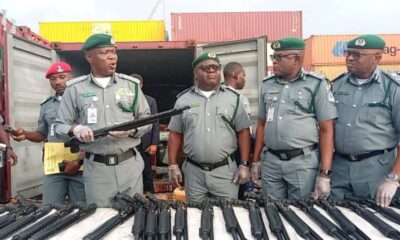
COUNTDOWN TO 2027 ELECTIONS: Customs Hands Over 399 Seized Rifles To NCCSALW .

Ex-NPA MD, Hadiza Bala Usman, Set To Deliver Keynote Address At MAMAL 2026.

NAGAFF Petitions IGP On Alleged Police Extortion, Harassment At Sea Ports.

NAGAFF Deplores Foreign Domination of Freight Forwarding, Tasks Indigenous Operators to Form Combines.

NIWA, Private Agency Target Pollution Elimination, Job Creation To Clean Lagos Waterways.

Seme Customs Arrests 2, Intercepts Explosives, Expired Noodles As Command’s Revenue Hits N19.8bn.

FOU Zone ‘A’ Customs Recovers over N729m Revenue, Intercepts Smuggled Goods Worth N3.24bn.

Key Industry Stakeholders To Focus on Ports Competitiveness as MARAN Hosts MAMAL.

NAGAFF Tasks Bonded Terminals To Suspend All Illegal Fees Collections, Refund N178m.

CGC Restates Position on Illicit Arms, Unveils Intercepted Weapons and Drugs Worth N373m

Topfield College Clinches Overall Position as Customs’ WASA Sports Event ends in Lagos.

ECTS: PTML Customs Mounts an Awareness Campaign

AfCFTA: Nigeria, Cameroon, Benin To Establish Joint Customs Strategic Steering Committee on Beitbridge Communique.

TRANSQuest MAGAZINE @ 21: With Huge Maritime Endowments, Stakeholders Warn, Nigeria Can’t be Poor, Government Must Realign Her Priorities.

CSR: Customs CG Hosts Apapa Students in Sports, Pledges Sponsorship for Outstanding Young Athletes.

ABUJA MoU: WE FUNCTION BEHIND A MASK, says Capt Umoren

1. EXECUTIVE PLATFORM. AMES 2024: TIME TO CHANGE GOVERNMENT ATTITUDE TOWARDS SHIPPING DEVELOPMENT IS NOW, AMES President Charges FG.

2023 ELECTIONS:CILT Hosts Seminar on Logistics & Electoral Process

B’ODOGWU TRADE PORTAL: Customs Consolidates, Pilots Form ‘M’ Processing.

APFFLON Seeks Immediate Reform of CRFFN, Replacement of Registrar.

OMIS AWARDS, 2022: Greg Ogbeifun, Industry Gurus For Special Recognition.
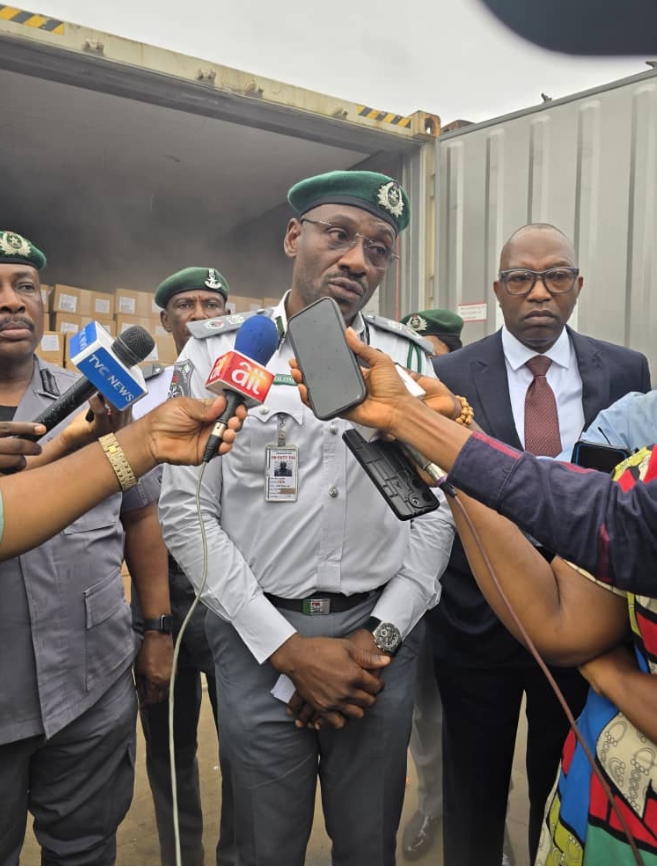
HALF YEAR, 2024: Apapa Customs Nets ₦1.024 Trillion, Records 143% Increase.
JANUARY-MAY REPORT: Seme Customs Hits N2.6bn, Facilitates ₦35.1bn Exports.

B’Odogwu: Apapa Customs Collects ₦161b in 3 Weeks, Assures of Improvements .

PHOTO NEWS: Maritime Capacity Development

FG Set To Re-establish National Shipping Line, To Take Advantage of $10 bn Annual Ship Charter Market.

Photo News: Salah Celebration

Sylvanus Ekpo, ex-Editor, Shipping World Magazine, loses Mum
Mama Theresa Enisuoh Due For Burial April 27
Adesuwa Ladoja Becomes MD/CEO, Lagos Free Zone.

MAN, ORON: It’s Encomiums Galore From International Seabed Authority (ISA).

-
 News3 weeks ago
Disaster Imminent in Apapa as Widening Cracks Overtake Liverpool-Marine Road Junction. ………. Stakeholders Send SOS to Government.
-
 Maritime Agencies3 weeks ago
CSR: Customs CG Hosts Apapa Students in Sports, Pledges Sponsorship for Outstanding Young Athletes.
-
 Maritime Agencies3 weeks ago
ECTS: PTML Customs Mounts an Awareness Campaign
-
 Maritime Agencies1 week ago
Seme Customs Arrests 2, Intercepts Explosives, Expired Noodles As Command’s Revenue Hits N19.8bn.
-
 Maritime Agencies3 weeks ago
TRANSQuest MAGAZINE @ 21: With Huge Maritime Endowments, Stakeholders Warn, Nigeria Can’t be Poor, Government Must Realign Her Priorities.
-
 Maritime Agencies3 weeks ago
AfCFTA: Nigeria, Cameroon, Benin To Establish Joint Customs Strategic Steering Committee on Beitbridge Communique.
-
 Maritime Agencies3 weeks ago
Topfield College Clinches Overall Position as Customs’ WASA Sports Event ends in Lagos.
-
 Maritime Agencies2 weeks ago
CGC Restates Position on Illicit Arms, Unveils Intercepted Weapons and Drugs Worth N373m