
Maritime
MAN, Oron, Takes To Alternative Energy To Save Costs

By Izuchukwu Ozoemena
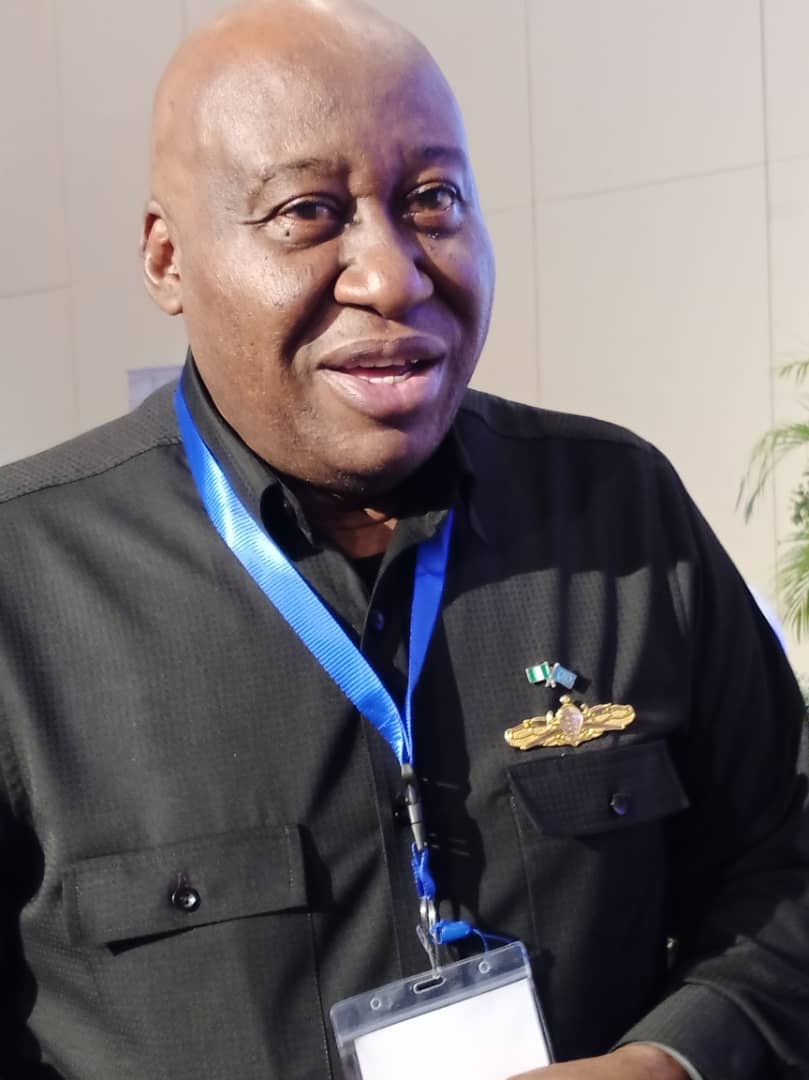
To cut the use of diesel, a commodity whose cost is becoming unbearable, the Maritime Academy of Nigeria (MAN), Oron, has resorted to renewable energy aimed at gradually phasing out diesel generators. This is more so as the initiative tallies with the International Maritime Organisation (IMO) arrangement to embrace renewable energy in order to cut down on sulphur gas emissions.
MAN Rector, Commodore Duja Emmanuel Effedua (Rtd) disclosed this in Lagos, Thursday, while delivering his goodwill message at the 2022 edition of the World Maritime Day (WMD).
The Academy which has already achieved a 25% implementation in this regard, he announced, targets to power her entire structure by solar energy except the simulators which require high voltage above the capacity of the available solar system.
He said it is time to save funds to augment the 5% Nigeria Maritime Administration and Safety Agency (NIMASA) funding and remain afloat in view of the current out-of-the-roof foreign exchange rate.
“As a school, we have been teaching our children on the future possibilities.The cost of diesel right now is N27m to N30m for one truck which we used to buy between N7m and N8m.
“We are a school, we cannot kill NIMASA. We cannot kill the Ministry of Transportation, asking for money. So, we have decided to go renewable.
“As at last week we were about 25%. By December, all our classrooms will be powered by solar; most of our offices same. We only use diesel when we need to use our simulators because they are big. Definitely, they will consume more power.”
Presently, he stated, things are better as MAN has gradually evolved into a world- class institution, ready to attract foreign earnings by way of internally-generated revenue. This is made possible having achieved capacity development of workers in specialized training for the maritime, oil and gas workforce. There are also courses for civil servants and other people in administration, safety and nautical services.
“We have evolved as an Academy. The nation should be proud now that they have an academy. When l first appeared on this podium in 2017, l wasn’t this confident. But with the support of the ministry and the maritime industry, we have evolved.
“In fact in Africa now, we are among the best three. There is nothing in any other academy anywhere in the world that we don’t have; the only thing is the colour of the skin. Some people still want to see the white man’s presence before things can happen. That is not true. We have evolved and we are grateful.”
The Rector stated that the challenge of greener shipping stems from the encroachment on nature by science. To get it right, he counselled, scientists must conduct extensive research and analysis to be able to come out with the better alternative energy.
“Talking about greener shipping 2050, just about 28 years away from now, it means scientists must work hard to ensure that emissions and the carbon signature is reduced to the barest level. That will be a very huge task and very expensive for our growth in the maritime industry.”
Commodore Effedua noted that as alternatives to carbon- producing energy like diesel and other forms of fossil fuels are numerous, care must be taken to ensure that the 2020 timeline given by IMO to implement alternative energy that will promote green shipping does not create more havoc for the third world countries where cheaper energy raw materials are being exploited.
“Do we go back to sail? That is possible. But we can’t because the tonnage of vessels have changed. Do we go back to steam, how efficient is steam? Diesel is still the most efficient. Let us not talk about nuclear energy that is a different thing entirely. Do we talk about hydrogen? Hydrogen is very fragile. With the pitching and wave of vessels, there could be accident onboard.
“If it is solar we want to think about, have you thought about tantalite, helium and cobalt? Where do they get them from, mostly from Africa. What will be the impact on the environment when people start mining these things? They will create more problems for us in Africa. So, these are the things we have been talking about with our cadets.”




Maritime Agencies
Customs Bans Stemming of Containers of Pharmaceutical Products To Bonded Terminals, Hands Over N9.2bn Illegal Importations To NAFDAC
By Izuchukwu Ozoemena
Going forward, the Nigeria Customs Service has placed an indefinite ban on the stemming of containers of pharmaceutical products to bonded terminals. This is official.
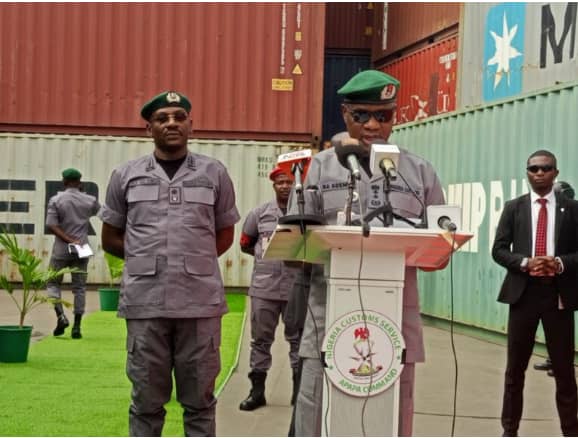
Customs Controller-General, Bashir Adewale Adeniyi announced this in Lagos, Friday, in response to what he referred to as abuses and trade illegalities being perpetrated by offdock facilities.
”We will no longer allow stemming vessels down into offdock facilities. We can allow any other thing but because of the sensitive nature of pharmaceutical products and because of the abuse to which this concession has been subjected in the past, they will only be allowed or cleared in these four designated places: Apapa Port (right inside the port), Onne Port, PTML and at the International Airport. We’ll no longer allow them to be taken into bonded terminals.”
The Controller-General who was in Apapa to hand over 25 containers of unregistered and prohibited pharmaceutical products with a Duty Paid Value (DPV) of N9.2 billion to the National Agency for Food and Drug Administration and Control (NAFDAC) declared the aim of the restriction. This is to curtail the abuse by bonded terminal operators, many of whom have been implicated in the seizure of fake and unwholesome drugs.
CGC Adeniyi described the seizure of pharmaceutical products as a direct fallout of the strategic Memorandum of Understanding with NAFDAC and the inauguration of the implementation committee between the two bodies in November 2024.
Explaining the Service’s position regarding current licensing fees, he stated that the current licensing fees for bonded terminals in operation stand to be reviewed as they no longer align with current realities, haven been in place for about a decade.
”The increase in the fee of the license has to be such that it will be difficult or impossible for those who are not serious to own and operate a bonded terminal.
”So, we are already in the process of reviewing the license fee. We will carry the stakeholders along and do things that will reflect current situations”.
He acknowledged the role inter-agency collaboration and intelligence-sharing have continued to play in enforcement.
This enhanced cooperation has delivered measurable results in protecting public health and discouraging illicit trade.
”The MOU framework enables Customs and NAFDAC to conduct coordinated operations and joint investigations, systematically tracing illicit pharmaceutical sources and deploying targeted enforcement strategies against criminal networks”.
A rundown of the contents of the
21 forty-foot containers and 4 twenty-foot containers of counterfeit and dangerous pharmaceutical reveals unregistered sexual enhancement drugs like REDSUN and HYEGRA among others.
There are also codeine-containing cough syrups (including CSC brands), antibiotic injections such as oxytetracycline and artesunate, pain relief medications containing diclofenac sodium and paracetamol.
Also included are skin-lightening creams, hip and breast enlargement products and
numerous tablets bearing fake NAFDAC registration numbers. Expired food products, veterinary medications and antimalarial drugs also featured.
“The Nigeria Customs Service, in partnership with NAFDAC and the NDLEA remains uncompromisingly committed to the battle against merchants of death who pursue illicit profits from businesses that destroy lives and communities,” Adeniyi stressed.
“This MOU- facilitated coordination enables swift responses to emerging threats, and I commend the Director-General and her dedicated team whose technical expertise, combined with our enforcement capabilities, has created a formidable barrier against criminal networks seeking to compromise our borders”.
“Under the coordination of the Office of the National Security Adviser, our joint operations have resulted in the seizure of over 200 containers followed by coordinated destruction exercises, with unregistered pharmaceutical products comprising 63.7% of seizure values, highlighting the scale of threats that could have inflicted devastating damage on human lives and our social ecosystem if permitted to infiltrate our markets,” he stated.
Adeniyi who emphasized that the Service has significantly enhanced her intelligence network and technological capabilities to detect and seize unwholesome goods warned all stakeholders including haulage operators, bonded terminal owners, or any other international trade facilitator that anyone implicated in illegality stands to face the full force of the law as there are no sacred cows.
He commended commended officers and men at the Apapa Port Command for being vigilant and professional in their duties.
Maritime Agencies
Lekki Deepsea Port Set To Clinch 500,000 TEUs, Becomes Trans-shipment Hub In West Africa
By Izuchukwu Ozoemena
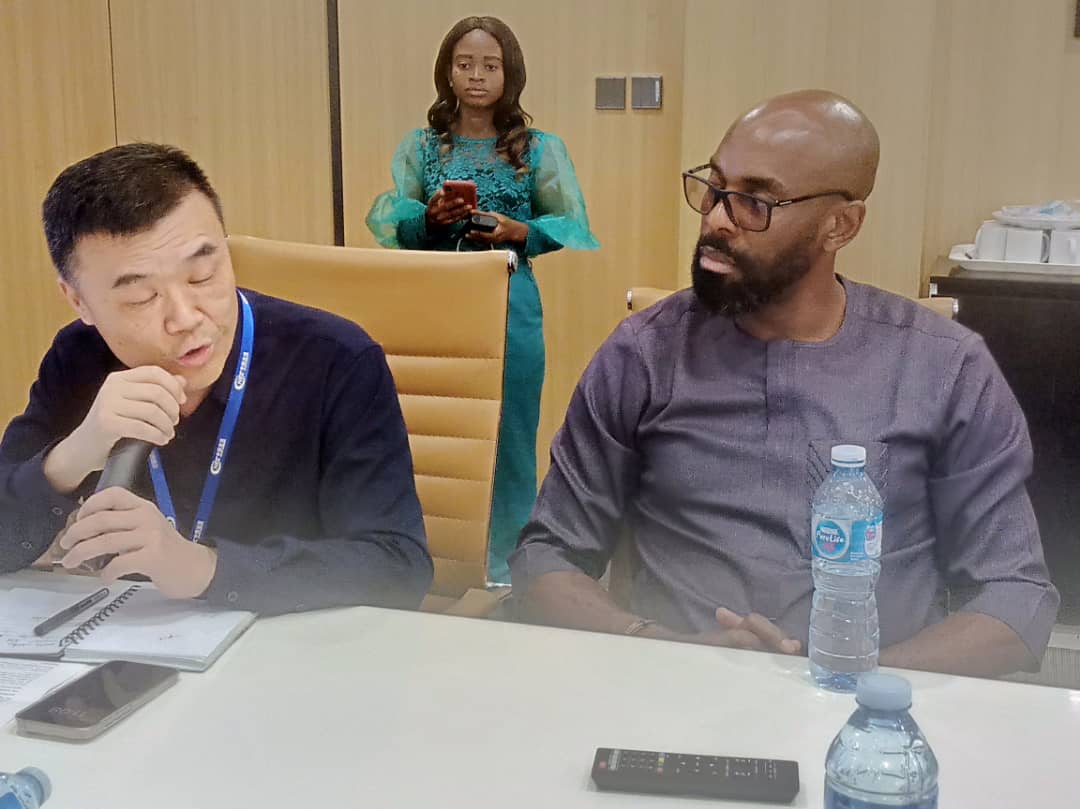
Yang Xixiong, the Chief Operating Officer, Lekki Port has said the deepsea port which commenced operations in 2023 has come to place Nigeria in her rightful position as a shipping hub that has assumed her rightful position and relevance in regional and global economy.
The CEO who disclosed this in Lagos,Thursday, while rubbing minds with members of the press assured that the new port has stabilized and would, going forward,continue to raise the bar of relevance to international standards.
“We continue to push the envelope, set the bar higher to uphold our position as West Africa’s deepest sea port,” Xixiong announced.
A section of critical facilities at the Lekki Deepsea Port.
“The result of our unrelenting commitment to world-class standards is visible in the gigantic footprints we are putting on the map of maritime trade in Africa, deploying technology, driving operational efficiency, and shaping regional trade,” he added.
Already, Lekki Port has commenced trans-shipment operations to some regional ports in West Africa such as Togo, Ghana and Côte d’Ivoire.
In his intervention, Daniel Odibe, Deputy Chief Operating Officer, who spoke further on the increase in trans-shipment capacity added that recently, Lekki Deepsea Port conducted a trial trans-shipment to Onne Port.
Odibe said, “We had our first trans-shipment operations in 2023, which is the first in the Nigerian economy.
Between January and June, 2025, the port processed 222,000 Twenty-foot Equivalent Units (TEUs) of cargo and has her hands steadily on the plough to jerk up the performance so as to achieve the targetted record of 500,000 TEUs by the end of the year, a development that reflects a growing confidence in the port’s ability to achieve maximum operational capacity as per international standards.
“Before now, countries like Togo, Ghana, and Côte d’Ivoire used to be the trans-shipment hubs for Nigeria-bound cargoes. You know what that means for our cargo? They spend more time coming to us. They incur more costs because they are double-handled in those trans-shipment hubs, all because Nigeria didn’t have a deep-sea port.
”The story is in our favour right now. We are now talking about international trans-shipment. We are now doing international trans-shipment to other West African countries such as Ghana, Côte d’Ivoire, Abidjan, Togo and Cotonou.
”Currently, you have ports like Warri, Calabar, Onne, and then we have inland ports like Onitsha and Burutu. Some of these ports, foreign vessels don’t go there because the draft is low. So the idea here is to have cargoes for those ports. That will open up economic opportunities in those areas.
“We did some trials last year with Onne. It had some challenges, but again, it was an eye-opener and we are looking at restarting that again this year in collaboration with the shipping lines and baggage operators.”
On cargo throughput volume, Odibe assured that cargo volumes are now gradually improving steadily despite initial hiccups arising from instability in the rate of the Dollar.
Currently, the port receives between 10-12 vessels every month. The record, he added, is steadily picking up.
“Volumes fell because of Naira depreciation and the removal of fuel subsidy; this caused a setback in our projection. As of 2023, when we started operations, we did 54,289 TEUs, and as of June of this year, we have done 222,000, and we are projecting 500,000 TEUs.”
Odibe also stated that the vessel turnaround time at Lekki Port currently stands at 48 hours as against one hour and 25 minutes for truck turnaround time, while cargo dwell time is 16 days.
Maritime Agencies
MAMAL 2025: MARAN Demands End to War Risk Premium, Set to Expose Maritime Fraud in Gulf of Guinea.
By Izuchukwu Ozoemena
Come August 28, 2025, the Maritime Reporters Association of Nigeria (MARAN) will host the 3rd edition of her annual Maritime Lecture (MAMAL) at the prestigious Eko Hotel and Suites, Lagos.
This year’s lecture will spotlight the ongoing international fraud perpetrated by foreign shipping lines under the guise of “War Risk Premiums” on vessels calling at Nigerian ports, aiming to draw the Federal Government’s urgent attention to the issue.
Speaking on the theme of MAMAL 2025 which is “Addressing the Burden of War Risk Insurance on Nigerian Maritime Trade,”MARAN President, Mr. Godfrey Bivbere, strongly condemned the war risk insurance, describing it as an international fraud burdening the economy of Nigeria and other developing countries in the Gulf of Guinea.
The extra war risk insurance (WRI) levied on Nigeria-bound vessels varies significantly. For instance, a very large crude carrier (VLCC) can incur a WRI surcharge of $445,000 per voyage, while a new container vessel may face a charge of $525,000 per voyage. Beyond this, some shipping companies such as Maersk, have introduced additional fees like a transit disruption surcharge, while others impose a war risk surcharge of $40-$50 per 20-foot container.
MARAN contends that these exorbitant charges are further strangulating Nigeria’s already-strained economy.
Also, despite Nigeria’s Minister of Marine and Blue Economy, Adegboyega Oyetola recently confirming that Nigeria has not recorded a single pirate incident in the past three years, the imposition of war risk premiums continues unabated.
Oyetola credits this peace in the Gulf of Guinea to the multi-billion naira Deep Blue Project, a robust maritime security initiative spearheaded by the Nigerian Maritime Administration and Safety Agency (NIMASA).
Despite these commendable efforts by the Federal Government, MARAN is concerned that foreign shipping lines continue to unjustly extract millions of dollars from Nigerian shipowners in the name of War Risk Insurance Premium, even though there are no demonstrable risks in the region.
In March 2025, Dr. Dayo Mobereola, Director General of NIMASA, met with a delegation from the Danish Ministry of Foreign Affairs, led by Kristin Skov-Spilling, where he passionately appealed to the international community to acknowledge Nigeria’s significant progress in securing its waters. He emphasized the critical need for a corresponding reduction in war risk insurance costs.
Dr. Mobereola stated, “The Nigerian government has demonstrated a strong commitment to maritime security, leading to nearly zero incidents of piracy and armed robbery in the Gulf of Guinea over the past four years. Despite this, vessels coming to Nigeria continue to pay high war risk premiums, which is unjustifiable given the improved security landscape.”
Speaking further on the upcoming MAMAL Annual Maritime Lecture 2025, MARAN President Godfrey Bivbere asserted that international shipping companies operating in Nigeria have shown “lackadaisical and complacent attitude towards the economic and social wellbeing of Nigeria as a nation.”
He explained that MAMAL 2025 aims to thoroughly examine the perceived threats, realities, and profound implications of persistent Extra War Risk Insurance (EWRI) on Nigeria’s maritime trade and the wider Gulf of Guinea (GoG).
Providing more details about the highly anticipated conference, which has consistently served as a crucial rallying point for all maritime stakeholders due to MARAN’s respected voice, Bivbere added:
”The Summit will also explore issues leading to the classification of the nation’s waters as high-risk zones, roles of classification societies like the Lloyds of London, the roles of core stakeholders like NIMASA, Nigerian Navy and other maritime and security operators.”
According to Bivbere, “The MAMAL 2025 is expected to draw over 500 key stakeholders, including maritime security experts, shipowners, terminal operators, international shipping lines, diplomats, insurers, regulators, and legal experts.”


Customs Bans Stemming of Containers of Pharmaceutical Products To Bonded Terminals, Hands Over N9.2bn Illegal Importations To NAFDAC

Lekki Deepsea Port Set To Clinch 500,000 TEUs, Becomes Trans-shipment Hub In West Africa

MAMAL 2025: MARAN Demands End to War Risk Premium, Set to Expose Maritime Fraud in Gulf of Guinea.

Apapa Customs Revives Rail Haulage of Cargo, Shuts Three Bonded Terminals

SAFETY ON WATER: FG Donates Life Jackets To Ogun State Government, Emphasizes Safety

Dangote Lauds NPA’s One-Stop Shop Committee, Donates Coaster Bus To Ease Operations

Release Approved N200bn Capital Projects Fund To MAN, Oron, House of Representatives Charges NIMASA .

NPA Berths Nigerian-Owned Container Vessel,”MV OCEAN DRAGON,” To Boost Incountry and Regional Trade,

NIGERIAN PORTS AUTHORITY BERTHS FIRST WHOLLY NIGERIAN-OWNED CONTAINER VESSEL.

HALF-YEAR REVENUE DISPOSITION: Apapa Customs Hits N1.38Trillion, Confiscates Prohibited Goods Worth Billions.

PORTBIZNESS Celebrates Excellence in Customer Service Delivery, Holds Special Awards Night

Kebbi Customs Command Introduces Health Screening, Mandatory Sports To Ensure Work-life Balance

CG Adeniyi Commends Ogun II Command for Massive Revenue Increase.
Container Movement To Seaports: NPA Meets With APM Terminals, Shipping Lines, for Coordination.

ANTI-SMUGGLING OPERATIONS: FOU, Zone ‘A’ Ups the Ante, Confiscates Bulletproof Vests, Cannabis Sativa,etc, worth N1.2bn

INLAND WATERWAYS SAFETY: Oyetola Flags Off 3,500 Life Jacket Distribution Campaign in Lagos.

APFFLON Seeks Immediate Reform of CRFFN, Replacement of Registrar.

OMIS AWARDS, 2022: Greg Ogbeifun, Industry Gurus For Special Recognition.

FG Set To Re-establish National Shipping Line, To Take Advantage of $10 bn Annual Ship Charter Market.

2023 ELECTIONS:CILT Hosts Seminar on Logistics & Electoral Process

INLAND WATERWAYS OFFERS NIGERIA ALTERNATIVE REVENUE SOURCE, Says Sambo

MAN, ORON: It’s Encomiums Galore From International Seabed Authority (ISA).

Photo News: Salah Celebration

MAN, Oron, Kick-starts Simulator-based Training, Commends FG, NIMASA.

MUAZU SAMBO: Showcasing Nigeria’s Maritime Potentials At The Global Arena

Lilypond Export Command Is Meeting Expectations, Handles 70% of Nigeria’s Total Tonnage of Export Cargo, says CAC Odusanya.

PHOTO NEWS: Maritime Capacity Development

BENIN SEAPORT UPDATE: Edo State Government, Host Communities, Conduct Bidders To Inspect Project Site.

MARAN Salutes DCG Adeniyi On His Elevation As Customs Comptroller-General.

WAR AGAINST OIL THEFT: Tompolo’s Company Nabs VLCC Laden With Crude Oil

PUBLIC RELATIONS: New Image Maker Mounts the Saddle at NPA.

SIFAX GROUP: Ojeniyi Becomes Sky Capital GMD, Omajuwa Strategy Director.

-
 Maritime Agencies2 weeks ago
PORTBIZNESS Celebrates Excellence in Customer Service Delivery, Holds Special Awards Night
-
 Maritime Agencies3 weeks ago
Kebbi Customs Command Introduces Health Screening, Mandatory Sports To Ensure Work-life Balance
-
 Maritime Agencies1 week ago
NPA Berths Nigerian-Owned Container Vessel,”MV OCEAN DRAGON,” To Boost Incountry and Regional Trade,
-
 Maritime Agencies3 days ago
Apapa Customs Revives Rail Haulage of Cargo, Shuts Three Bonded Terminals
-
 Maritime Agencies1 week ago
HALF-YEAR REVENUE DISPOSITION: Apapa Customs Hits N1.38Trillion, Confiscates Prohibited Goods Worth Billions.
-
 Maritime Agencies4 days ago
Dangote Lauds NPA’s One-Stop Shop Committee, Donates Coaster Bus To Ease Operations
-
 Maritime Agencies1 week ago
NIGERIAN PORTS AUTHORITY BERTHS FIRST WHOLLY NIGERIAN-OWNED CONTAINER VESSEL.
-
 Maritime Agencies3 days ago
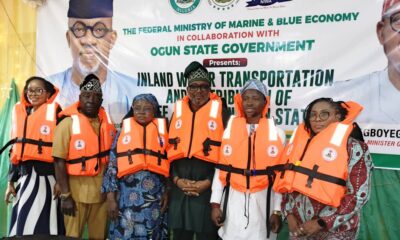
SAFETY ON WATER: FG Donates Life Jackets To Ogun State Government, Emphasizes Safety