
Maritime
MAN, Oron, Takes To Alternative Energy To Save Costs

By Izuchukwu Ozoemena
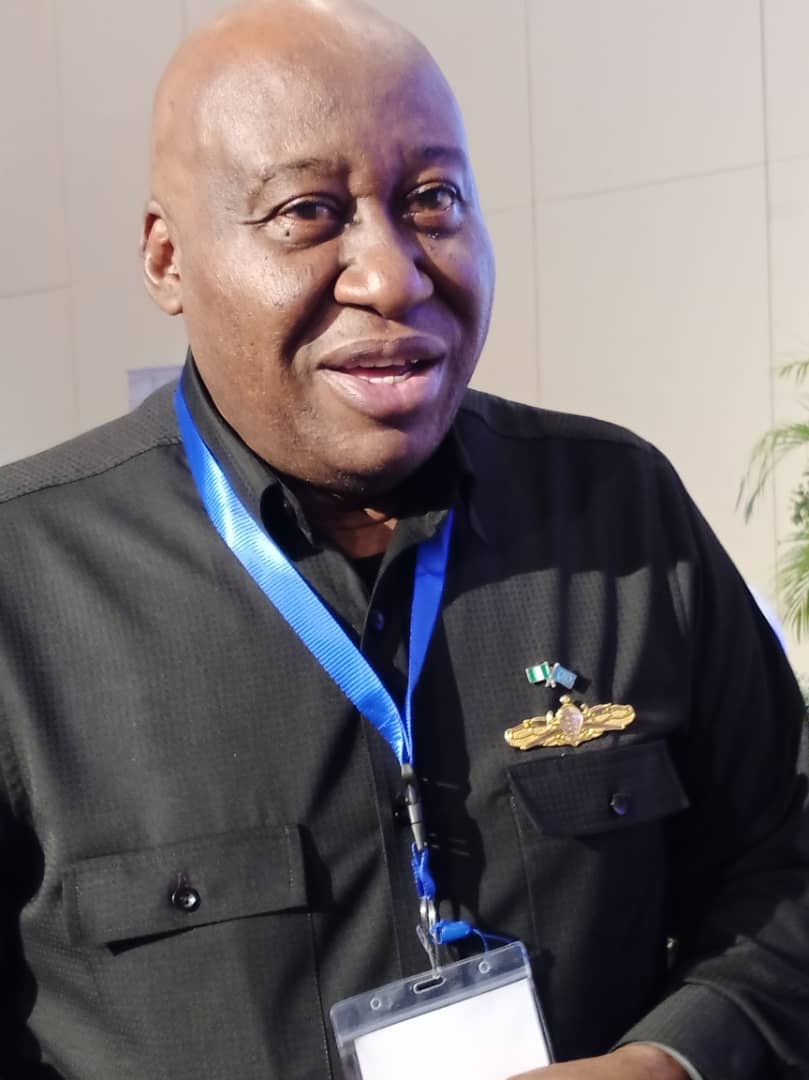
To cut the use of diesel, a commodity whose cost is becoming unbearable, the Maritime Academy of Nigeria (MAN), Oron, has resorted to renewable energy aimed at gradually phasing out diesel generators. This is more so as the initiative tallies with the International Maritime Organisation (IMO) arrangement to embrace renewable energy in order to cut down on sulphur gas emissions.
MAN Rector, Commodore Duja Emmanuel Effedua (Rtd) disclosed this in Lagos, Thursday, while delivering his goodwill message at the 2022 edition of the World Maritime Day (WMD).
The Academy which has already achieved a 25% implementation in this regard, he announced, targets to power her entire structure by solar energy except the simulators which require high voltage above the capacity of the available solar system.
He said it is time to save funds to augment the 5% Nigeria Maritime Administration and Safety Agency (NIMASA) funding and remain afloat in view of the current out-of-the-roof foreign exchange rate.
“As a school, we have been teaching our children on the future possibilities.The cost of diesel right now is N27m to N30m for one truck which we used to buy between N7m and N8m.
“We are a school, we cannot kill NIMASA. We cannot kill the Ministry of Transportation, asking for money. So, we have decided to go renewable.
“As at last week we were about 25%. By December, all our classrooms will be powered by solar; most of our offices same. We only use diesel when we need to use our simulators because they are big. Definitely, they will consume more power.”
Presently, he stated, things are better as MAN has gradually evolved into a world- class institution, ready to attract foreign earnings by way of internally-generated revenue. This is made possible having achieved capacity development of workers in specialized training for the maritime, oil and gas workforce. There are also courses for civil servants and other people in administration, safety and nautical services.
“We have evolved as an Academy. The nation should be proud now that they have an academy. When l first appeared on this podium in 2017, l wasn’t this confident. But with the support of the ministry and the maritime industry, we have evolved.
“In fact in Africa now, we are among the best three. There is nothing in any other academy anywhere in the world that we don’t have; the only thing is the colour of the skin. Some people still want to see the white man’s presence before things can happen. That is not true. We have evolved and we are grateful.”
The Rector stated that the challenge of greener shipping stems from the encroachment on nature by science. To get it right, he counselled, scientists must conduct extensive research and analysis to be able to come out with the better alternative energy.
“Talking about greener shipping 2050, just about 28 years away from now, it means scientists must work hard to ensure that emissions and the carbon signature is reduced to the barest level. That will be a very huge task and very expensive for our growth in the maritime industry.”
Commodore Effedua noted that as alternatives to carbon- producing energy like diesel and other forms of fossil fuels are numerous, care must be taken to ensure that the 2020 timeline given by IMO to implement alternative energy that will promote green shipping does not create more havoc for the third world countries where cheaper energy raw materials are being exploited.
“Do we go back to sail? That is possible. But we can’t because the tonnage of vessels have changed. Do we go back to steam, how efficient is steam? Diesel is still the most efficient. Let us not talk about nuclear energy that is a different thing entirely. Do we talk about hydrogen? Hydrogen is very fragile. With the pitching and wave of vessels, there could be accident onboard.
“If it is solar we want to think about, have you thought about tantalite, helium and cobalt? Where do they get them from, mostly from Africa. What will be the impact on the environment when people start mining these things? They will create more problems for us in Africa. So, these are the things we have been talking about with our cadets.”




Maritime Agencies
NAGAFF President, Chief Ezisi, Visits PTML Customs, Urges Deepened Customs-Freight Forwarders Partnership.
By Izuchukwu Ozoemena
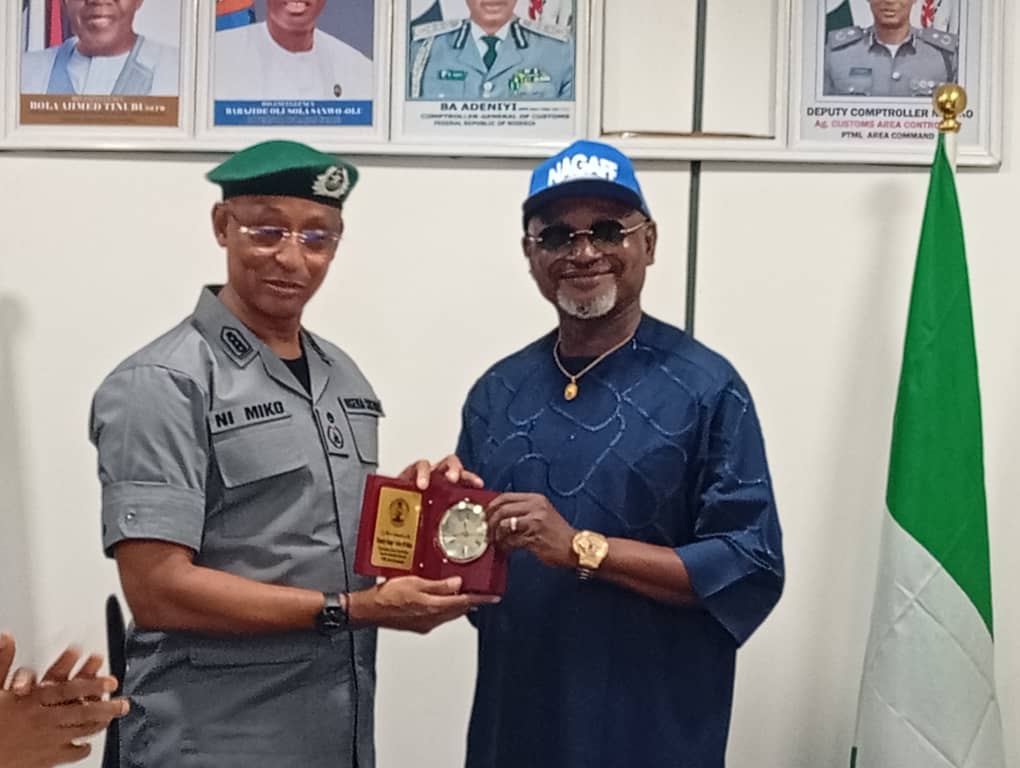
Chief Tochukwu Ezisi, National President, National Association of Government Approved Freight Forwarders (NAGAFF) has given kudos to the Controller of the PTML Command of the Nigeria Customs Service, Comptroller N. I. Miko, for the support extended to freight forwarders at PTML, enjoining him to sustain the tempo and assist the NAGAFF chapter to deepen the relationship for mutual benefits.
Chief Ezisi made the commendation, Thursday, when he led the association’s high command on a familiarization visit to the Customs Area Controller (CAC) of the PTML Command.
Ezisi who used the opportunity to welcome the CAC to the Customs Command also introduced the newly-elected executive of the NAGAFF PTML Chapter democratically elected to manage its affairs for the next four years.
Describing NAGAFF as a law-abiding organisation which has maintained a longstanding relationship with the Customs Service, Chief Ezisi stressed the importance of collaboration, compliance and professionalism in facilitating legitimate trade.
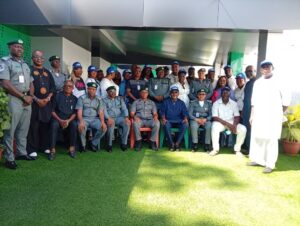
He urged Miko to maintain open communication with the chapter’s leadership and whenever disagreements or operational challenges arose, the national leadership would intervene where necessary to resolve issues.
As in other large organisations, Ezisi acknowledged, members with different dispositions and approaches to matters populate NAGAFF and managing them and their differences remains the hallmark of effective leadership at all times.
He also told the CAC that as a body, NAGAFF has in place an active special intervention outfit, a compliance team with guiding slogan, “If you see something, say something.” This body monitors the activities of her members and other freight forwarders who willingly subvert compliance standards in the line of duties.
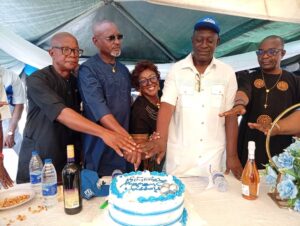
NAGAFF, he explained, is a non-profit association of freight forwarders whose headquarters relies on the contributions and activities of its chapters to fulfill its responsibilities to the industry.
In his response, the Customs Area Controller of the PTML Command, Comptroller Nura Ibrahim Miko, assured NAGAFF members of the Command’s continued cooperation. He described the relationship between Customs officers and freight forwarders at the terminal as very cordial and will always be, going forward.
Miko recalled NAGAFF’s organizational structure, describing it as impressive, particularly the commitment to training and capacity development of members through the NAGAFF Academy .
The PTML Command would continue to support freight forwarders, the CAC pledged as Customs officers and industry operators would continue to deepen the existing harmony and cooperation in the workplace.
He assured that the Command would continue engaging terminal operators on the need to improve the working environment for both Customs officers and freight forwarders.
Miko encouraged freight forwarders to report any shortcomings in the conduct of Customs officers, assuring them that the command would take feedback seriously and work towards improvement.
He also urged stakeholders to acknowledge good performance, emphasising that constructive engagement, mutual respect and collaboration were essential to effective operations.
He reaffirmed his management’s readiness to sustain the healthy relationship with the association and other stakeholders.
Giving a vote of thanks, NAGAFF’s Vice President (Headquarters), Simeon Nwonu, expressed pleasure of the assurance of a continued cordial relationship and accessibility stakeholders associate CAC Miko with right from the Apapa Command.
He thanked Comptroller Miko for the warm reception, expressing confidence that NAGAFF members operating at PTML would benefit from continued engagement.
Maritime Agencies
Ogun 1 Customs Hits Smugglers Hard 15 Days into New Leadership, Intercepts N3.15 bn Contrabands.
By Izuchukwu Ozoemena
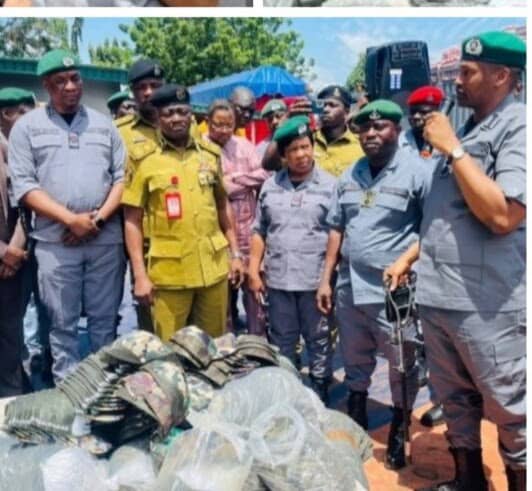
Within 15 days of taking over as the Acting Customs Area Controller, Ogun 1 Customs Command, Deputy Comptroller Abdulhamid Ibrahim has hit the ground running, intercepting 43 consignments of prohibited and improperly imported goods whose Duty Paid Value (DPV) stand at N3.15 billion.
The Acting CAC stated this, Thursday, when he addressed the press at the Command’s headquarters, Idiroko, Ogun State. He pledged his commitment to intensify enforcement operations to prevent prohibited goods from entering the country through Nigeria’s borders with the Republic of Benin.
The seizures, which include foreign rice, pasta, pharmaceutical products, cannabis, petroleum products and 13 exotic vehicles, underscore the command’s renewed offensive against smuggling and other forms of economic sabotage.
Attributing the swift success to intelligence-driven strategies, intensified surveillance and collaboration with sister security agencies and border communities,
he warned smugglers that the Command would not tolerate activities capable of undermining the nation’s economy, public health and national security.
“From the outset, I made it clear that Ogun I Area Command under my watch would not tolerate any form of economic sabotage. We are determined to deploy all lawful means to combat smuggling and enforce compliance with existing trade laws and regulations,” Ibrahim stated.
On October 2, 2026, he explained, trucks conveying large quantities of foreign pasta and condensed milk suspected to have been smuggled into the country were confiscated.
”The first truck contained 2,740 cartons of foreign Siddo Pasta concealed alongside 500 cartons of Oki Condensed Milk, while the second carried 6,000 cartons of foreign Ginny Pasta. The third truck was loaded with 6,500 cartons of foreign Doga Pasta.
The trucks were subsequently moved to the command’s headquarters for physical examination in accordance with Section 227 of the Nigeria Customs Service Act, 2023.”
On October 4, he added, officers intercepted a Dangote truck along the Afamin-Dangote-Itori axis conveying 100 bags of 50kg foreign parboiled rice concealed beneath mica and gypsum stones in an apparent attempt to evade detection.
Yet on October 11, the Command also intercepted a 10-tyre truck containing 321 military camouflage face caps and 27,831 assorted unregistered pharmaceutical products.
The pharmaceutical products included codeine-based cough syrups, injections, eye drops and dietary supplements without registration numbers from the National Agency for Food and Drug Administration and Control (NAFDAC).
Ibrahim deplored the illegal importation of restricted military accessories and unregistered medicines with serious implications for national security and public health respectively.
“These seizures are not merely about confiscating prohibited goods. They are about protecting our citizens, safeguarding public health, defending our national security and ensuring that legitimate businesses are not undermined by illegal trade,” Comptroller Ibrahim said.
The trucks involved in the major interceptions, he disclosed, would be forfeited to the Federal Government in accordance with Section 248 of the Nigeria Customs Service Act, 2023.
Other items seized during the period included 4,013 parcels of cannabis sativa, one wrap of Canadian Loud, 950 litres of Premium Motor Spirit (PMS), 660 bags of 50kg foreign parboiled rice, four bundles of used pneumatic tyres, 106 bales of second-hand clothing, 1,320 pairs of new shoes, 3,700 pairs of used shoes, 252 imported face caps and 1,250 foreign-used bags.
Ogun 1 Command also impounded 13 exotic foreign-used vehicles, including Hyundai Tucson, Honda CR-V, Toyota Venza, Lexus LX 600, Lexus ES 350, Toyota Camry, Toyota Avensis Verso, Peugeot 406, Ford Galaxy and Nissan Almera models.
Ibrahim put the total Duty Paid Value of the 43 seizures at N3,153,591,000, describing the figure as evidence of the command’s determination to frustrate smuggling networks and protect the Nigerian economy.
He expressed particular concern over the interception of cannabis, warning that the substance poses significant risks to young people, public health and national security.
As part of efforts to strengthen inter-agency cooperation, the command formally handed over the seized cannabis to the National Drug Law Enforcement Agency (NDLEA), Idiroko Special Area Command, for further investigation and necessary action.
He attributed the operational successes to the leadership and support of the Comptroller-General of Customs, Bashir Adewale Adeniyi, MFR, who continues to c provide strategic direction and motivation to officers across the country.
As he acknowledged the contributions of sister security agencies, traditional institutions, youths and border communities to the fight against smuggling, he praised his officers and men for being resilient and professional in discharging their duties.
“The message is clear: smugglers and their collaborators should steer clear of Ogun I Area Command. We remain committed to protecting the nation’s economic and security interests with professionalism, integrity and courage,” he warned.
In his intervention, Akande Olasumbo Oluwafemi, the Commander, NDLEA Idiroko Special Area Command, commended the Customs Service for intercepting the prohibited substances and pharmaceutical products.
Oluwafemi described the seizures as an important intervention in efforts to combat drug abuse and disrupt the supply chains through which illicit substances reach consumers.
He expressed concern over the increasing abuse of codeine-based cough syrups among Nigerian youths, noting that products originally intended for legitimate medical use were being misused because of their addictive properties.
“Initially, codeine was something mixed with other ingredients in cough syrups. But because of addiction, our youths now buy a bottle of codeine and swallow the entire contents at once,” he lamented.
He stressed the importance of sustained cooperation between the Customs Service and the NDLEA in identifying, intercepting and preventing the circulation of illicit drugs and unregistered pharmaceutical products.
Maritime Agencies
Lekki Port Customs Confiscates 400kg of Suspected Cannabis Sativa Worth over N2.26bn, Hands over To NDLEA.
By Izuchukwu Ozoemena
The new Acting Customs Area Controller, Lagos Free Trade Zone (LFTZ) Area Command of the Nigeria Customs Service, Deputy Comptroller Olufemi Kukoyi has harped on the importance of inter-agency collaboration as per the directive of the Comptroller -General of the Nigeria Customs Service, Dr Bashir Adewale Adeniyi.
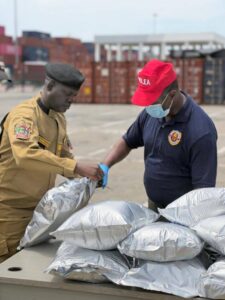
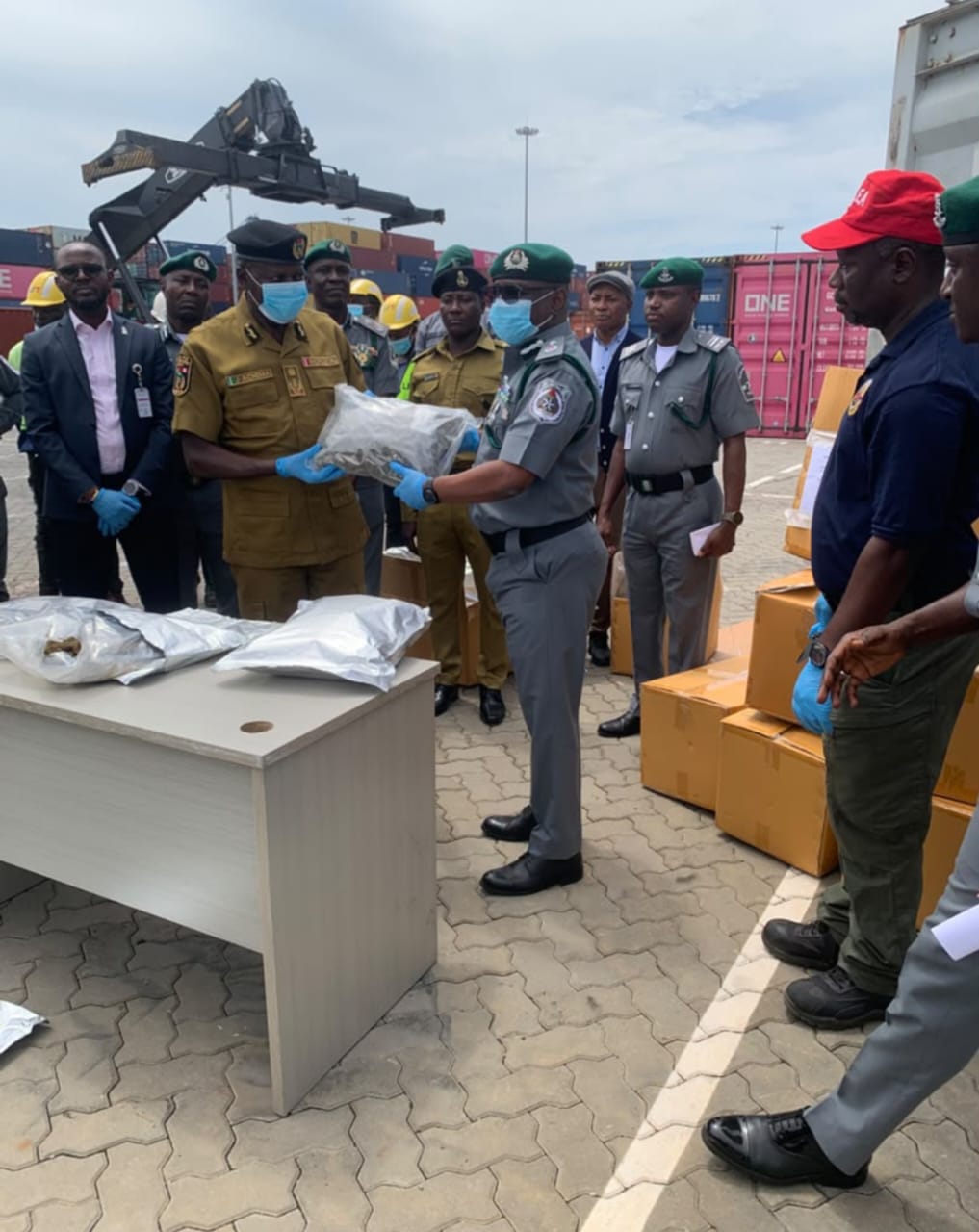
He stated this at the Lekki Port Command, Thursday, while handing over to the National Drug Law Enforcement Agency (NDLEA) a seized container laden with 400 kilograms of suspected Cannabis Sativa.
Acting on credible intelligence, he explained, officers of the Command under his watch intercepted the suspicious container with registration number PRSU1562064, which had arrived at Lekki Deep Sea Port and was, under the Customs transire procedure, destined for a bonded terminal outside the Command through the waterways by barge.
“However, recognizing the potential security implications and the risks associated with allowing a suspicious consignment to leave the port environment, the Command took the proactive decision to step down the container for further scrutiny.
“In line with established Customs procedures and our intelligence-driven enforcement strategy, the container was subjected to non-intrusive inspection through scanning. The scanning report revealed anomalies that necessitated a comprehensive physical examination.
Following from this, a joint examination was conducted at Lekki Freeport Terminal by officers of the Nigeria Customs Service (NCS), National Drug Law Enforcement Agency (NDLEA), Department of State Services (DSS), and National Agency for Food and Drug Administration and Control (NAFDAC), DC kukoyi explained.
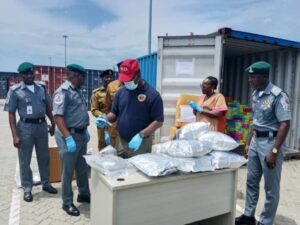
“During the examination, seven pallets of packaged goods were discovered. Upon opening and thoroughly examining the pallets, officers uncovered substances suspected to be illicit narcotics, ingeniously concealed among reams of A4 printing paper in an apparent attempt to evade Customs detection.”
The comprehensive examination revealed 400 packages of substances suspected to be Cannabis Sativa, commonly referred to as “Loud,” with a total weight of 400 kilograms tactically tucked into 798 reams of A4 printing paper which are not prohibited items.
The Duty Paid Value, the Customs boss announced was N2,262,960,000.00.
Kukoyi described the seizure as a significant victory for public safety, national security and eloquent commitment and determination of the sister security agencies to assist the Customs to protect Nigerian society from the devastating consequences of drug trafficking and abuse.
He underscored the destructive impact of illicit drugs on the communities, particularly among young people, noting that beyond their devastating health implications, illicit drugs contribute to addiction, organized crime, insecurity, family disintegration and the erosion of the nation’s productive human capital.
“The successful detection of this consignment before its onward movement from Lekki Port further reinforces the strategic importance of proactive risk management and coordinated border security operations”.
He commended the vigilance, professionalism and dedication of the Command’s officers, the cooperation of the NDLEA Lekki Port Command and other sister agencies like DSS, NAFDAC and the management of Lekki Freeport Terminal throughout the operation.
“This achievement is a practical demonstration of what can be accomplished when government agencies work together with a common purpose, share intelligence and place national interest above institutional boundaries.
“The handover underscores the unwavering resolve of the NCS to safeguarding the nation’s borders, protect public health and security and ensure that the ports and trade corridors are never exploited as gateways for illicit substances and other prohibited goods”.
Receiving the seized items, the Commander of Narcotics (CN), NDLEA Lekki Port Area Command, Jonah Achema, remarked that the collaboration sends a very strong signal that the new CAC is ready to embrace inter-agency collaboration as well as move the counter-narcotic onslaught to the next level.
“It sends the appropriate message to the unscrupulous maritime drug criminals that their operations will only end in the drag net of the Agency.
“The seizure being handed over today, standing at 400 kilograms of Cannabis indica from Thailand is huge by all standards. This is coming after other phenomenal seizures in the Port such as two containers of illicit pharmaceutical opioids (tramadol 225, tramaking royal 250) with a total weight of 46 tonnes and an estimated street value of N35 Billion”.
He assured LFTZ Acting Customs Controller and other sister agencies that the NDLEA remains consistent and unwavering to do everything to sustain the existing collaboration with the Nigeria Customs.


NAGAFF President, Chief Ezisi, Visits PTML Customs, Urges Deepened Customs-Freight Forwarders Partnership.

Ogun 1 Customs Hits Smugglers Hard 15 Days into New Leadership, Intercepts N3.15 bn Contrabands.

Lekki Port Customs Confiscates 400kg of Suspected Cannabis Sativa Worth over N2.26bn, Hands over To NDLEA.

MARAN Trains Members at Shipping Institute, Pledges Sustained Capacity Building.

Deputy Comptroller Nkiru Nwala Takes Over C’River, Calabar FTZ and Akwa Ibom Customs Command, Succeeds Comptroller Momodu Dauda.

The Price Of The Byline: When Journalists Cannot Afford To Live

Operation Whirlwind’ Auctions 22,175 Litres of PMS, Deepens Fight Against Petroleum Products Smuggling,

NIGERIA @ 66: AMBO Media Front Pinpoints Signs of a Prosperous Future .

CHANGE OF BATON AT OGUN 1 CUSTOMS: A.A.Ibrahim Succeeds O.O.Afeni, Pledges Intelligence-Driven Enforcement.

SPORTS: Group Unveils United Nigeria Airlines Ndigboamaka Traders’ Cup, 2026.

Traders’ Umbrella Group Evaluates State of the Nation, Expresses Serious Concerns of the Trading Public.

Tantita’s Oil Pipeline Surveillance Yields Huge Dividend, Shoots Nigeria’s Q2 Oil Exports Earnings To $9.39bn.

Ehingbeti Summit: Stakeholders Say Coastal Communities Need Funding for Development.

Ogun 1 Customs Repeats Stern Warning To Smugglers, Confiscates Latest Brand of Range Rover, Other Contrabands.

Unregulated Deployment of Unmanned Vessels Threatens Maritime Security — Navy.

Nigeria Collaborates with Benin Republic to Launch Modernised Joint Customs Border Post.
JANUARY-MAY REPORT: Seme Customs Hits N2.6bn, Facilitates ₦35.1bn Exports.

2023 ELECTIONS:CILT Hosts Seminar on Logistics & Electoral Process

ABUJA MoU: WE FUNCTION BEHIND A MASK, says Capt Umoren

1. EXECUTIVE PLATFORM. AMES 2024: TIME TO CHANGE GOVERNMENT ATTITUDE TOWARDS SHIPPING DEVELOPMENT IS NOW, AMES President Charges FG.
HALF YEAR, 2024: Apapa Customs Nets ₦1.024 Trillion, Records 143% Increase.

B’Odogwu: Apapa Customs Collects ₦161b in 3 Weeks, Assures of Improvements .

B’ODOGWU TRADE PORTAL: Customs Consolidates, Pilots Form ‘M’ Processing.

APFFLON Seeks Immediate Reform of CRFFN, Replacement of Registrar.

OMIS AWARDS, 2022: Greg Ogbeifun, Industry Gurus For Special Recognition.

PTML Customs Hits Over N350Bn in 9 Months, Intercepts ₦200m Illicit Pharmaceuticals,

IMPRESSIVE REVENUE DRIVE: Tincan Customs Generates ₦154.3Bn In October.

PHOTO NEWS: Maritime Capacity Development
Adesuwa Ladoja Becomes MD/CEO, Lagos Free Zone.

Photo News: Salah Celebration

Information Minister Highlights President Tinubu’s Achievements, says 2025 Is A Year of Consolidation.

FG Set To Re-establish National Shipping Line, To Take Advantage of $10 bn Annual Ship Charter Market.

-
 Maritime Agencies3 weeks ago
Traders’ Umbrella Group Evaluates State of the Nation, Expresses Serious Concerns of the Trading Public.
-
 Maritime Agencies3 weeks ago
CHANGE OF BATON AT OGUN 1 CUSTOMS: A.A.Ibrahim Succeeds O.O.Afeni, Pledges Intelligence-Driven Enforcement.
-
 Maritime Agencies3 weeks ago
SPORTS: Group Unveils United Nigeria Airlines Ndigboamaka Traders’ Cup, 2026.
-
 Maritime Agencies3 weeks ago
Tantita’s Oil Pipeline Surveillance Yields Huge Dividend, Shoots Nigeria’s Q2 Oil Exports Earnings To $9.39bn.
-
 Maritime Agencies1 week ago
Deputy Comptroller Nkiru Nwala Takes Over C’River, Calabar FTZ and Akwa Ibom Customs Command, Succeeds Comptroller Momodu Dauda.
-
 Maritime Agencies2 weeks ago
NIGERIA @ 66: AMBO Media Front Pinpoints Signs of a Prosperous Future .
-
 Maritime Agencies1 week ago
MARAN Trains Members at Shipping Institute, Pledges Sustained Capacity Building.
-
 Maritime Agencies2 weeks ago
Operation Whirlwind’ Auctions 22,175 Litres of PMS, Deepens Fight Against Petroleum Products Smuggling,