
Customs
PTML CUSTOMS Command Nets N182bn In 3rd Quarter, 2022.


By Izuchukwu Ozoemena
Between the months of January to September, 2022, the Ports Terminal Multiservices Limited (PTML) Command of the Nigeria Customs Service ( NCS) realized a total revenue of N182,103,291,166.00.
This shows a 10 per cent increase or an amount of N17,379,074,244.00 when compared to N165,021.614,645.00 collected in the equivalent period in 2021.
The highest increment was recorded in July with 29.9%, followed by May 2022 with 28% rise in revenue collection.
A month-on-month breakdown of the revenue collection between 2021 and 2022 shows that the Command made N15,205,823,545 in January 2021 and N15,713,776,798 in January 2022, showing a 3.3% increase.
In February of the previous year, it recorded a 20% increase after raking in N14,075,386,963 in 2022, as against N11,706,947,150 in 2021, while March 2022 saw a 9.5% rise with N21,840,828,908:00 collected, compared to N19,937,869,175 in the previous year.
Although its April 2022 performance of N16,357,509,497 did not match that of the previous year of N17,938,794,417, it however made up for that in May, following a 28% boost with N22,550,759,092 collected as against N17,606,073,741 made in the previous year.
In June 2022, the Command collected N27,029,957,255, indicating a 21.5% appreciation from N22,253,694,223 made the previous year, while July 2022 saw it recorded 29.9% increase, the highest collection so far with N25,389,607,638, when compared to the N19,532,512,815 generated in 2021.
For August and September 2022, the Command failed to surpass collections of the previous year after generating N21,766,390,771(-0.3.1%) and N17,379,074,244.30 (-8.5%), as against N21,835,143,596 and N19,004,755,983 respectively.
In a statement by SC Mohammed Yakubu, the Command image maker, the Customs Area Controller, Mr Bomai reassured importers of Roll on Roll off(RoRo) cargoes of the command’s capacity to process clearance of imported vehicles within four hours.
He said the command will rely on utmost compliance which include sincere declaration, prompt duty payment ,readiness for timely examination, zero level of smuggling and concealment to sustain the feat.
The CAC urged officers to step up their revenue collection efforts as well as sustain zero tolerance for infractions as the year comes to an end.



Customs
Kaila, Seme Customs Boss, Pledges To Eradicate Trade Barriers, Visits Stakeholders To Create Awareness.
By Izuchukwu Ozoemena
The Seme Area Command of the Nigeria Customs Service (NCS) has restated a strong desire to ensure free movement of goods and services along the Lagos-Abidjan international trade corridor by eradicating all negative factors involved. This it is implementing through effective collaboration and engagement with critical stakeholders.
This is contained in a release by the Command’s image maker, Superintendent of Customs J.T. Ayagbalo, on behalf of Comptroller Kaila, the Customs Area Controller.
While on a series of familiarization visits to the Palaces of traditional rulers and stations of heads of sister security agencies, the CAC announced that the step signifies a bold commitment to achieving the goals and objectives of the Service in line with the Federal government economic policies.

At the Palace of Oba Akran of Badagry Kingdom, the Customs Area Controller condoled with the royal family and entire people of Badagry kingdom on the passing away of HRM De Wheno Aholu Menu Toyi I, a highly recognized traditional ruler across the border communities and beyond.
””The purpose of my visit is to introduce myself as the Area Controller of Seme Command and to equally seek your royal blessing and support to achieve the core mandate of the service. Our priority remains to generate revenue, facilitate trade and suppress smuggling. And we in the Customs believe that without due support and co-operation from traditional rulers, we cannot have effective performance of our functions as Customs officers” he said.
In response, the King Regent, Chief Abel Ogunbiyi, described Kaila as a son of the soil, added: “We have listened to your request. Know that Badagry is a very peaceful town, and we will keep collaborating with you in safeguarding our borders and in promoting legitimate trade, ” he stated.
Comptroller Kaila also visited the Onibereko of Ibereko Awori-Kingdom, where the monarch, Oba Israel Okoya where he signified his commitment to fostering the service’s relationship with residents living within the border communities
”I welcome you to Badagry and be rest assured that I will always talk to my people whenever the need is required. In our town, our youth does not engage in illegalities as I have no other choice than to assist you in achieving the government mandate, ” he stated.
While at the Palace of Alapa of Apa Kingdom the king HRM Oba Oyekan Ajose Ilufemiloye commended and described the CAC, Comptroller Kaila as a professional, seasoned and well respected officer as described by indigenes of border communities.
”I promise you that I will always assist you in my area for anything that you need. Our border here has been peaceful because our youth always listen to the elders, and I know with your present here, things will change for the better, ” he said
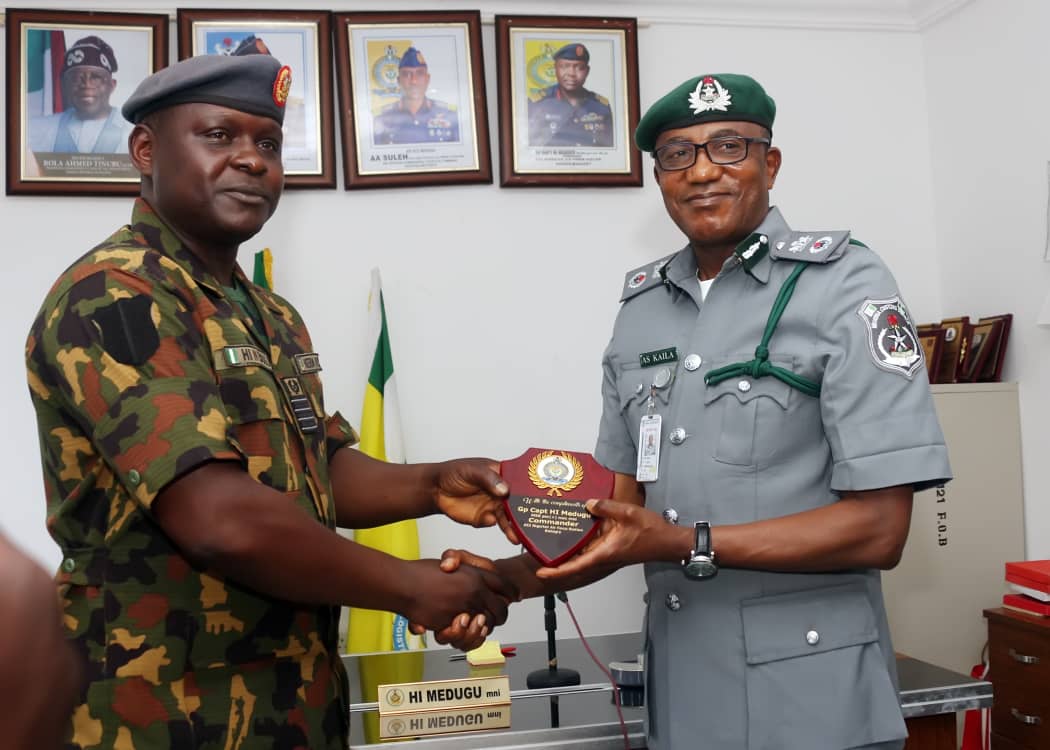
In his efforts to consolidate on existing synergy between sister security agencies, the controller visited Headquarters of 653 Nigerian Air force base, Ahanve-Badagry. The Air Force base formation expressed their readiness to always support the command in achieving its mandate. This was revealed by the Commanding Officer, Group Captain Hungruy Medugu, where he added that both agencies shared similar purposes.
”Our collaboration has been key to various successes we have recorded in our area of responsibility. Your presence here strengthens existing bonds of inter-agency collaboration between both Services, and we will not take it for granted ,” he said
The Area Controller then ended his familiarization tour by seeking for mutual cooperation with a visit to the Republic of Benin Police office showing his readiness to eradicate hindrances affecting the free movement of goods and services across the border.
Customs
Ogun 1 Customs Hosts FAED 2026, Highlights Gains of Cross-Border Cooperation, Economic Empowerment and Entrepreneurial Development.
By Izuchukwu Ozoemena
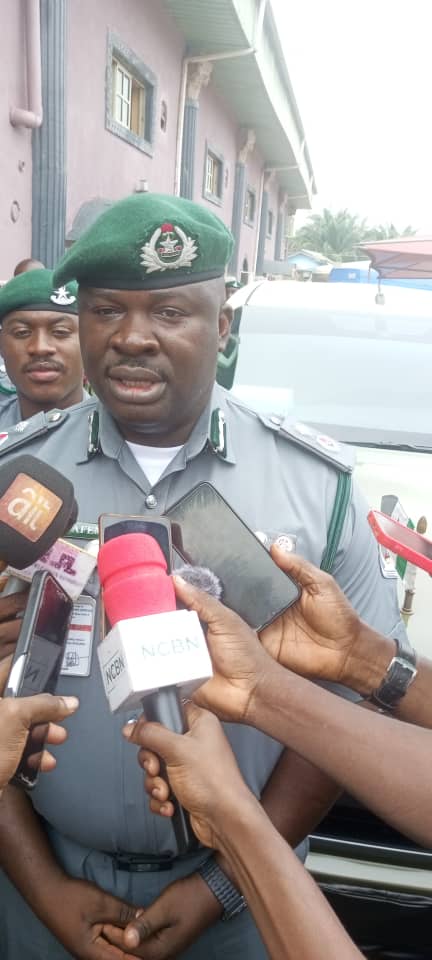
The Acting Customs Area Controller (CAC), Ogun Area 1 Command of the Nigeria Customs Service, Deputy Comptroller O.O.Afeni says the Festival of Arts For Economic Development (FAED) continues to reflect a shared understanding that sustainable border management goes beyond enforcement to encompass cross-border cooperation, economic empowerment and entrepreneurship development within the border communities.
Deputy Comptroller Afeni spoke at the Idiroko Border, Thursday, while declaring open the international colloquium to mark the 5th edition of the Festival of Art for Economic Development to which the Nigeria Customs Service is a strategic partner.
He said: “The theme, ‘Rebranding Borderline Communities through Creative Empowerment and Entrepreneurship,’ aligns with the Nigeria Customs Service’s commitment to supporting legitimate trade, encouraging value addition, and promoting small-scale enterprises as drivers of economic growth and border stability.

Dr Bonny Abisogun Botoku, Executive Producer, FAED.
He acknowledged the important role of the Nigeria–Benin Inter-Border Forum, under the leadership of its Permanent Secretary, Dr. Bonny Abisogun Botoku in advancing preventive diplomacy, structured dialogue and operational cooperation between Nigeria and the Republic of Benin.
”Through the empowerment programmes and entrepreneurship initiatives embedded in this Festival, we see practical pathways to reducing illicit activities, strengthening lawful commerce, and fostering inclusive economic opportunities for our people.”

Deborah Chiamaka Nwangene, one of the graduating trainees.
”The Nigeria Customs Service remains committed to partnerships that promote peaceful borders, resilient economies and sustainable regional integration.”
During a brief press chat, Comptroller Afeni spoke about enforcing government fiscal policies, saying that this must not be by force.
”The citizens must be made to know the reasons we are here. This is a way of showing the communities that we care about them. You can see that we have trained some people in the art of garri- making painting tye and dye (adire), etc. It’s a way of empowering the community.”
On suggestions that the seminar is capable of deepening cordial relationship between Benin and Nigeria, the CAC could not agree less.
”It is the fifth edition. It has been a situation we see the succeeding version getting better than the previous one. Today, I signed many certificates of people graduating. We’re not just training them; we’re empowering them so that we take them off the smuggling realm and make them better citizens.”
In his presentation, the Executive Producer of the Festival, Dr Bonny Abisogun Botoku described it as more than an event.
”It is a movement. It is a statement of belief—that border communities are not problems to be managed, but potentials to be unlocked.”
He recalled that for too long, border communities across Africa have been spoken about only in the language of risks exemplified in smuggling, insecurity, informality and marginalization.
”But those of us who live and work at the borders know a deeper truth. Borders are not just lines on maps. They are meeting points of culture, gateways of trade,
and spaces of shared history.
Sample of garri processed and packaged by a trainee.
”The Nigeria–Benin border is not a dividing line—it is a shared civilization. What we are doing through this Festival is to change the story from suspicion to trust, from survival to enterprise,
from isolation to integration.
Contrary to the widely-held belief that culture only concerns entertainment, he explained, culture is power, identity and economic capital.
”Through art, music, fashion, crafts, food systems, and storytelling, communities rediscover pride, cohesion, and voice.
Culture becomes a language of peace, dialogue, and diplomacy—especially in border spaces where differences must be managed with wisdom.
”This Festival deliberately places culture at the center of development, not at the margins.”
Distinguished guests at the event included the Onitaege of Itaege, HRM Oba Matthew Ademola Abisoye and other respected traditional rulers, government officials and representatives of security agencies. Others were partners from the Republic of Benin, artists, cultural practitioners and trainees.
Customs
Freight Forwarders Warn FAAN To Halt New Charges In Airport Cargo Operations or Risk Rumble in the Sector .

By Izuchukwu Ozoemena
If the recent arbitrary increase in charges by the Federal Airports Authority of Nigeria (FAAN) is not reviewed, cargo operations across airports nationwide risk disruption, prompting huge losses in government revenue, airports freight forwarders have warned.
Leaders of major associations operating at the nation’s airports stated this in Lagos, Tuesday. The associations included the National Association of Government Approved Freight Forwarders (NAGAFF), the Association of Nigerian Licensed Customs Agents (ANLCA), African Professionals Freight Forwarders and Logistics of Nigeria (APFFLON) and NAFFAC.
Featuring at the briefing, among others, were Dr. Segun Musa, Deputy National President of NAGAFF in charge of Air and Logistics, and Mr. Tope Akindele, Chairman, Airport Chapter of ANLCA.
Speaking on behalf of the groups, Dr. Musa traced the controversy to an agreement reached with FAAN in 2010 over the collection of a seven-naira-per-kilogram levy on cargo, which, according to him, was tied to the allocation of land for the development of a cargo village at the airport.
He explained that prior to that agreement, FAAN had been collecting two naira per kilogram, a charge the freight forwarders had challenged on the grounds that FAAN, having concessioned cargo operations to companies such as NAHCO and SAHCOL, was not directly provding cargo handling services.
He said the associations had formally written FAAN at the time, arguing that the two-naira charge was illegal, a move that led to prolonged negotiations that reportedly lasted for about two weeks and disrupted activities at the airport. According to him, an eventual compromise was the introduction of the seven-naira charge in exchange for the allocation of land to build a cargo village, a deal he said formed the basis for the current arrangement.
“The seven naira we are talking about is attached to this land. It is like rent on this land,” Musa said, insisting that FAAN had no right to impose fresh charges without first engaging stakeholders. He argued that, just as the Nigerian Ports Authority (NPA) relates with terminal operators after concessioning the seaports, FAAN should deal with its concessionaires rather than directly imposing charges on operators.
The freight forwarders also raised financial concerns, claiming that FAAN had already made substantial sums from the seven-naira levy over the years. Musa said that in 2010 alone, FAAN collected over one billion naira from the charge and that from 2010 to date, the cumulative amount would be far higher than the value of the land allocated for the cargo village.
The immediate trigger for the latest dispute, according to the associations, is FAAN’s decision to increase the existing charges without consultation, a move they said was followed by a threat letter warning of possible demolition of their secretariats. The groups described this as coercive and counterproductive, stressing that they were not opposed to a review of charges but it must be done through dialogue.
Instead of imposing higher fees, they argued, FAAN should work with operators to create an enabling environment that would increase cargo throughput, which in turn raise revenue. “The more cargo we have, the more revenue they generate,” Musa said, adding that the present approach would only hurt all parties involved.
Mr. Tope Akindele, Chairman of ANLCA Airport Chapter, said the ongoing standoff had already begun to affect revenue generation. He noted that cargo activities had slowed in recent days because many operators were staying away from work in protest. According to him, if a concessionaire that used to make about one billion naira weekly is now making roughly half of that, continued disruption could lead to even worse outcomes for government revenue.
He stressed that the associations were not trying to sabotage government earnings, noting that any revenue yet to be paid due to the slowdown would still be collected once normal operations resume. “We want government daily revenue to continue. We are not frustrating government revenue. We are ready to continue paying, but let us dialogue within the shortest time so our job can commence,” he said.
Akindele also argued that globally, increments in charges are usually benchmarked around 25 per cent, adding that this was the standard the associations were willing to consider. Beyond that, he said, stakeholders should jointly explore ways to increase cargo volume rather than rely solely on higher levies.
Other speakers at the briefing raised concerns about what they described as multiple layers of charges on the same cargo. They pointed out that cargo handlers and airlines already collect various fees per kilogram, which are ultimately linked to FAAN, and argued that imposing additional charges on freight forwarders amounts to double or even triple taxation within the same cargo chain.
One of the speakers claimed that aside payments to cargo handlers and airlines, some charges could reach as high as 30 naira per kilogram in certain instances, warning that piling more levies on operators would further increase the cost of doing business and weaken the competitiveness of Nigeria’s air cargo sector.
The associations also recalled that the original dispute over the legality of the levy had not been fully resolved in court, but was set aside in favour of a mutual understanding aimed at keeping the industry running. They warned that if FAAN proceeds unilaterally or attempts to formalise the new charges without broad stakeholder agreement, the matter could return to the courts.
The freight forwarders called on the Minister of Aviation to intervene and prevail on FAAN to open talks with stakeholders. They stressed that they were not protesting, not carrying placards, and not seeking confrontation, but were instead asking for engagement that would lead to a mutually beneficial resolution.
They warned that if cargo operations at airports across the country were to grind to a halt, the wider economy would suffer, describing such a scenario as a “lose-lose” situation for operators and government alike. Despite the tension, they said they had advised members nationwide to continue working and avoid actions that could escalate the situation.
The associations assured the Federal Government that once negotiations begin, normal operations would resume immediately, with the existing status quo maintained pending the outcome of discussions. They also reiterated their willingness to work with FAAN and other government agencies to grow cargo volumes and, by extension, government revenue.
“We are here to appeal. We are not here to threaten or to protest or to cause a breakdown of law and order,” Musa said. He added that most operators depend on daily airport activities to feed their families and sustain their businesses.


2026 World Maritime Day: Nigeria Subscribes to Safer Waterways and Excellence.

NAGAFF President, Chief Ezisi, Visits PTML Customs, Urges Deepened Customs-Freight Forwarders Partnership.

Ogun 1 Customs Hits Smugglers Hard 15 Days into New Leadership, Intercepts N3.15 bn Contrabands.

Lekki Port Customs Confiscates 400kg of Suspected Cannabis Sativa Worth over N2.26bn, Hands over To NDLEA.

MARAN Trains Members at Shipping Institute, Pledges Sustained Capacity Building.

Deputy Comptroller Nkiru Nwala Takes Over C’River, Calabar FTZ and Akwa Ibom Customs Command, Succeeds Comptroller Momodu Dauda.

The Price Of The Byline: When Journalists Cannot Afford To Live

Operation Whirlwind’ Auctions 22,175 Litres of PMS, Deepens Fight Against Petroleum Products Smuggling,

NIGERIA @ 66: AMBO Media Front Pinpoints Signs of a Prosperous Future .

CHANGE OF BATON AT OGUN 1 CUSTOMS: A.A.Ibrahim Succeeds O.O.Afeni, Pledges Intelligence-Driven Enforcement.

SPORTS: Group Unveils United Nigeria Airlines Ndigboamaka Traders’ Cup, 2026.

Traders’ Umbrella Group Evaluates State of the Nation, Expresses Serious Concerns of the Trading Public.

Tantita’s Oil Pipeline Surveillance Yields Huge Dividend, Shoots Nigeria’s Q2 Oil Exports Earnings To $9.39bn.

Ehingbeti Summit: Stakeholders Say Coastal Communities Need Funding for Development.

Ogun 1 Customs Repeats Stern Warning To Smugglers, Confiscates Latest Brand of Range Rover, Other Contrabands.

Unregulated Deployment of Unmanned Vessels Threatens Maritime Security — Navy.
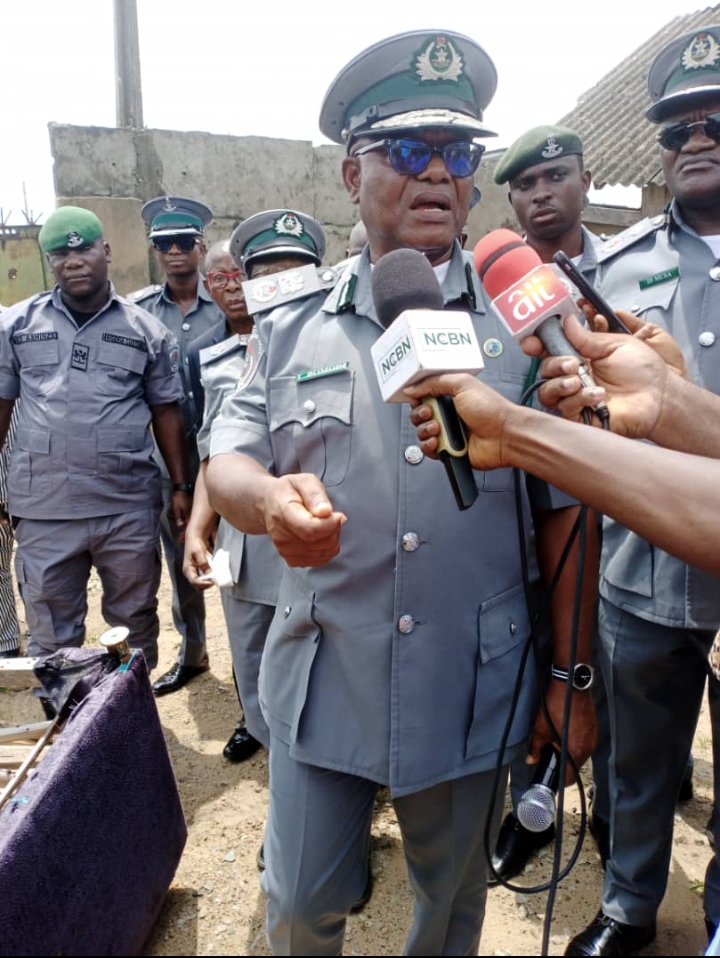
JANUARY-MAY REPORT: Seme Customs Hits N2.6bn, Facilitates ₦35.1bn Exports.

2023 ELECTIONS:CILT Hosts Seminar on Logistics & Electoral Process

ABUJA MoU: WE FUNCTION BEHIND A MASK, says Capt Umoren

1. EXECUTIVE PLATFORM. AMES 2024: TIME TO CHANGE GOVERNMENT ATTITUDE TOWARDS SHIPPING DEVELOPMENT IS NOW, AMES President Charges FG.
HALF YEAR, 2024: Apapa Customs Nets ₦1.024 Trillion, Records 143% Increase.

B’Odogwu: Apapa Customs Collects ₦161b in 3 Weeks, Assures of Improvements .

B’ODOGWU TRADE PORTAL: Customs Consolidates, Pilots Form ‘M’ Processing.

PTML Customs Hits Over N350Bn in 9 Months, Intercepts ₦200m Illicit Pharmaceuticals,

APFFLON Seeks Immediate Reform of CRFFN, Replacement of Registrar.

OMIS AWARDS, 2022: Greg Ogbeifun, Industry Gurus For Special Recognition.

IMPRESSIVE REVENUE DRIVE: Tincan Customs Generates ₦154.3Bn In October.

PHOTO NEWS: Maritime Capacity Development
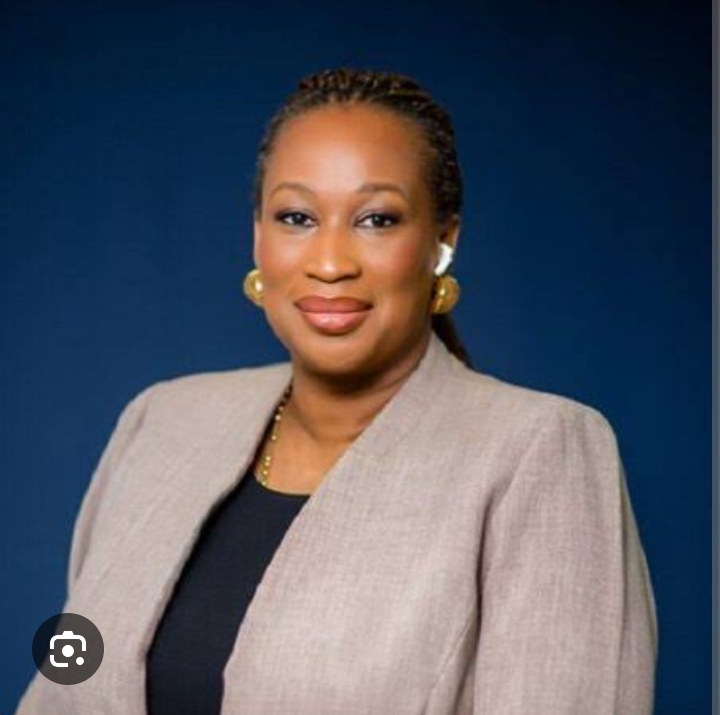
Adesuwa Ladoja Becomes MD/CEO, Lagos Free Zone.

Photo News: Salah Celebration

Information Minister Highlights President Tinubu’s Achievements, says 2025 Is A Year of Consolidation.

FG Set To Re-establish National Shipping Line, To Take Advantage of $10 bn Annual Ship Charter Market.

-
 Maritime Agencies3 weeks ago
Traders’ Umbrella Group Evaluates State of the Nation, Expresses Serious Concerns of the Trading Public.
-
 Maritime Agencies3 weeks ago
CHANGE OF BATON AT OGUN 1 CUSTOMS: A.A.Ibrahim Succeeds O.O.Afeni, Pledges Intelligence-Driven Enforcement.
-
 Maritime Agencies3 weeks ago
SPORTS: Group Unveils United Nigeria Airlines Ndigboamaka Traders’ Cup, 2026.
-
 Maritime Agencies3 weeks ago
Tantita’s Oil Pipeline Surveillance Yields Huge Dividend, Shoots Nigeria’s Q2 Oil Exports Earnings To $9.39bn.
-
 Maritime Agencies2 weeks ago
Deputy Comptroller Nkiru Nwala Takes Over C’River, Calabar FTZ and Akwa Ibom Customs Command, Succeeds Comptroller Momodu Dauda.
-
 Maritime Agencies2 weeks ago
MARAN Trains Members at Shipping Institute, Pledges Sustained Capacity Building.
-
 Maritime Agencies2 weeks ago
NIGERIA @ 66: AMBO Media Front Pinpoints Signs of a Prosperous Future .
-
 Maritime Agencies2 weeks ago
Operation Whirlwind’ Auctions 22,175 Litres of PMS, Deepens Fight Against Petroleum Products Smuggling,